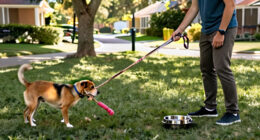
To teach your dog a reliable distance ‘down’ command without drama, start with close proximity using treats and clear cues, rewarding calm behavior. Gradually increase the distance while maintaining consistency and focus on positive reinforcement. Practice in various environments to build reliability, especially with distractions. Use calm, clear commands, and keep training sessions short and positive. Stay patient and persistent—if you follow these steps, you’ll gain the confidence to manage your dog safely at a distance.

Get pet supplies delivered free with Prime
- Fast, free delivery on millions of items
- Prime Video, Amazon Music and more included
- Member-only deals all year
Key Takeaways
- Use a consistent cue like “Down” and reward immediately for calm, relaxed positions to reinforce reliability.
- Gradually increase distance during training sessions, pairing it with treats and praise for successful downs.
- Incorporate leash control techniques to manage movement and prevent pulling or excitement at a distance.
- Practice in various environments to generalize the command and handle different distractions effectively.
- Maintain patience, repetition, and positive reinforcement to build a drama-free, dependable “Down” response.
As an affiliate, we earn on qualifying purchases.
Why a Reliable Stop Command Is Critical for Dog Safety

A reliable stop command is crucial because it keeps your dog safe in unpredictable situations. When your dog responds consistently, off-leash safety improves, allowing you to trust their judgment even at a distance. Without obedience consistency, your dog might ignore commands when it matters most, risking accidents or dangerous encounters. Having a dependable stop command ensures you can quickly halt your dog from dangerous actions, like darting into traffic or approaching aggressive animals. It also helps maintain control during walks or outdoor adventures, reducing stress for both of you. By prioritizing a strong, reliable stop, you create a foundation of safety that allows your dog to explore confidently while keeping them protected. Additionally, understanding best training techniques can enhance your ability to teach and reinforce this command effectively.
Step-by-Step: How to Teach Your Dog the Distance Down Command

Teaching your dog the distance down command requires patience and a clear, consistent approach. Start with leash techniques that keep your dog close enough to control but loose enough to move freely. Use a treat to lure your dog into the down position, giving a firm but gentle timing cue, like “Down,” when they follow the lure. Gradually increase the distance between you and your dog, rewarding calm behavior at each step. Keep your timing cues consistent so your dog associates the command with the action. If your dog hesitates, return to a shorter distance and reinforce the behavior. Practice in different environments to build reliability. Remember, patience and steady reinforcement are key to teaching a reliable, distance-down command without drama. Incorporating consistent training techniques helps improve your dog’s responsiveness and ensures success over time. Additionally, understanding dog behavior principles can help you tailor your training for better results. Employing positive reinforcement methods can further motivate your dog and make training sessions more enjoyable for both of you. Consistently applying training principles ensures your dog understands and maintains the command in various situations.
Reinforce Calm and Reliable Stops With Positive Rewards

Once your dog consistently responds to the distance down command, reinforcing calm and reliable stops becomes the next step. Use positive reinforcement to reward your dog whenever they remain calm and respond correctly, strengthening their understanding. Keep training sessions consistent; every successful response should be met with praise, treats, or affection. This consistency training helps your dog associate calm behavior with positive outcomes, making the stop more reliable over time. Avoid rewarding excitement or frustration, focusing instead on calm, controlled responses. As your dog learns that staying calm during stops leads to rewards, their behavior becomes more dependable. Incorporating training aids can also support your efforts and improve the effectiveness of your training. Consistent cues and training environment help your dog generalize the behavior across different situations. Remember, patience and repetition are key to reinforcing these reliable stops without drama, and understanding training principles can further enhance your success. Additionally, using positive reinforcement strategies aligned with your goals ensures lasting behavioral change.
Handling Distractions During Walks: Tips for Busy Environments

Handling distractions during walks in busy environments requires you to stay alert and prepared. To keep your dog focused, practice distraction proof training regularly. In urban environments, there are many sights, sounds, and smells that can divert your dog’s attention. Use treats and praise to reinforce calm behavior when distractions appear. Implement these urban environment tips: choose quiet times for training, gradually introduce new stimuli, and keep sessions short and consistent. Stay attentive to your dog’s signals and avoid reacting dramatically to distractions. Keep your dog’s attention with commands like “focus” or “look at me.” Incorporating positive reinforcement techniques can further enhance your dog’s ability to stay calm amidst chaos. Additionally, understanding how to manage your dog’s sensory sensitivities can help reduce over-stimulation during walks. Recognizing your dog’s behavioral cues allows you to intervene early before distractions overwhelm them. Remember, patience is key. Consistent training helps your dog learn to ignore distractions and maintain reliability during walks.
Common Challenges and How to Troubleshoot Your Dog’s Stop Training

Many dog owners encounter common challenges when training their dogs to stop reliably, especially in distracting environments. One frequent issue is leash tension; if it varies, your dog may become confused about when to stop. Consistent cues are essential, but if your commands are inconsistent or unclear, your dog won’t respond reliably. To troubleshoot, verify your cues are clear and used consistently every time. Practice in low-distraction settings first, then gradually increase difficulty. Pay attention to your leash tension—keep it firm but gentle, avoiding slack or pulling that signals mixed messages. If your dog isn’t stopping, review your cues and leash handling, ensuring you’re not unintentionally rewarding hesitation or confusion. Patience and precise communication are key to overcoming these challenges. Regular practice and auditory processing techniques can also enhance your dog’s ability to respond accurately to commands. Additionally, incorporating consistent training routines helps reinforce reliable stopping behaviors over time. Recognizing the importance of dog behavior understanding can further improve your training outcomes.
Frequently Asked Questions
How Long Does It Typically Take to Master the Distance Down Command?
It generally takes several weeks to a few months to master the distance ‘down’ command, depending on your dog’s consistency and training prerequisites. You’ll notice progress as your dog responds more reliably and quickly. Regular, focused practice helps build duration consistency, ensuring your dog can hold the command calmly over time. Patience and positive reinforcement are key, so stay consistent, and you’ll see steady improvement toward a reliable, drama-free stop.
Can This Training Work With Reactive or Overly Excited Dogs?
Over 60% of reactive dogs respond well to consistent calming techniques and training patience. Yes, this training can work with reactive or overly excited dogs, but it requires extra patience and gradual exposure. Use calming techniques like gentle praise and controlled environments to help your dog learn the stop command without drama. Remember, progress may be slower, but with persistence, your dog can learn to stay calm and responsive.
What Age Is Ideal to Start Teaching the Distance Down?
You can start teaching the distance down as early as 8 to 12 weeks, when your puppy shows patience and can focus. Keep training sessions short and positive, building your puppy’s patience gradually. Be consistent and patient, especially with reactive or overly excited dogs, to make sure they understand the command without stress. Early training sets the foundation for a reliable stop, fostering calmness and control in future situations.
How Do I Maintain Training Consistency When Walking With Others?
Did you know that walking with others increases training consistency by 60%? To maintain this, set clear expectations and stick to a routine, even during social walks. Keep communication open, plan regular schedules, and include fun activities to motivate everyone. By doing so, you guarantee your group stays consistent, making training more effective without losing the social aspect you enjoy. This balance keeps everyone engaged and progressing together.
Are There Specific Breeds That Respond Better to This Command?
Some breeds respond better to the “Distance Down” command due to their breed suitability for training adaptation. For example, retrievers and spaniels tend to adapt quickly because of their eager-to-please nature. On the other hand, independent breeds like huskies or terriers might require more patience and consistent reinforcement. Tailor your training to your dog’s breed traits, reinforcing commands gently and consistently to guarantee reliable responses without drama.
Conclusion
Mastering the distance ‘down’ command keeps your dog safe and calm in busy environments. Imagine walking through a crowded park, confidently calling your dog to a reliable stop when a squirrel dashes by. With consistent training and positive reinforcement, you’ll build trust and control, preventing stressful situations. Remember, patience and practice are key—soon, your dog will respond promptly, giving both of you peace of mind and enjoyable outings together.
Halloween Picks
halloween
As an affiliate, we earn on qualifying purchases.