
TL;DR

Get pet supplies delivered free with Prime
- Fast, free delivery on millions of items
- Prime Video, Amazon Music and more included
- Member-only deals all year
A Veterinary Practice News report examines how veterinary practices can assess returns on AI, pointing to documentation, diagnostic support and client communication as possible sources of value. It offers no single ROI figure: practices need baseline metrics and sustained staff use to judge whether a tool is paying off.
A Veterinary Practice News report says veterinary clinics cannot reliably tell whether artificial intelligence is paying off without measuring work before and after adopting a tool. The report identifies clinical documentation, diagnostic support and client communication as areas where AI may help, while stressing that results depend on staff adoption and the outcomes a practice tracks.
The report does not give a typical dollar return or claim that AI produces the same outcome in every clinic. Instead, it describes potential benefits such as less time spent finishing records after appointments, more complete same-day charts and fewer staff hours spent on reminders and outbound calls. These are possible operational gains, not quantified financial results in the report.
For documentation software, practices can record average chart-completion time, the share of records completed that day and after-hours charting hours per veterinarian. For communication tools, suggested measures include no-show rates, reminder response rates and call volume or time. The report says diagnostic-support tools are harder to assess financially, but record completeness or missed-charge frequency may be tracked.
Tom Walsh, a veterinarian and owner of PrimePet Rehabilitation Therapy in Myrtle Beach, South Carolina, said clinical documentation delivered his office’s first clear benefit. He said the tool listened during visits and drafted notes while he and clients talked, which he said supported cleaner handoffs and fewer missed details on busy therapy days. His account is an individual practice example, not a measured return applicable to all clinics.
How Clinics Can Measure AI Returns
The report says a smoother-feeling workday alone does not establish that an AI subscription has produced a return. It recommends setting a starting benchmark and a defined goal to assess whether a change occurred. Tracking relevant measures can help a practice evaluate whether a tool saves time or reduces administrative work relative to its cost.
Documentation assistants may affect after-hours charting, while communication tools may affect the volume of routine calls handled by reception staff. Without regular use or records of the previous workload, a practice may be unable to attribute or compare any change. The report presents adoption and measurement as factors in assessing returns, rather than automatic results of buying software.
AI veterinary medical scribe software for veterinary clinics
As an affiliate, we earn on qualifying purchases.
As an affiliate, we earn on qualifying purchases.
AI Use Is Growing in Veterinary Clinics
The article cites a 2024 survey of 3,968 veterinary professionals conducted by Digitail with the American Animal Hospital Association. It reports that 39.2% of respondents were already using AI tools or software in their practice; among those who had tried AI, nearly 70% said they used it daily or weekly. Another 38.7% said they were interested in adopting AI soon.
Those figures describe reported use and interest, not financial performance. The report argues that adoption alone cannot show whether a clinic has gained time or improved a workflow. It recommends collecting two to four weeks of baseline data before introducing a tool, with the measures selected to match the problem the clinic wants to address.
“Clinical documentation gave us our first real win.”
— Tom Walsh, DVM, owner of PrimePet Rehabilitation Therapy
The Payoff Has No Single Figure
The report provides no general ROI percentage, dollar estimate or payback period for AI in veterinary practices. It also does not present comparative financial results across clinics or establish that any one tool will produce the same benefits elsewhere. Walsh’s experience is a single-practice example.
It is also unclear from the source how survey respondents defined AI use, which products they used or how representative their experiences were of veterinary practices overall. The report warns that a tool may be underused after a top-down rollout, but the supplied material gives no adoption rate or quantified estimate of how often that happens. Actual returns remain practice- and tool-specific.
Track Results After Rollout
The report recommends that clinics choose a specific workflow goal, collect baseline measures for two to four weeks, and compare results after introducing the tool. It also recommends involving expected users, providing training and checking whether use continues after rollout.
The source does not identify a new study, deadline or industry-wide evaluation scheduled next. For an individual clinic, post-adoption results can show whether the selected measures change, whether staff continue using the tool and whether observed operational gains offset its expense.
Key Questions
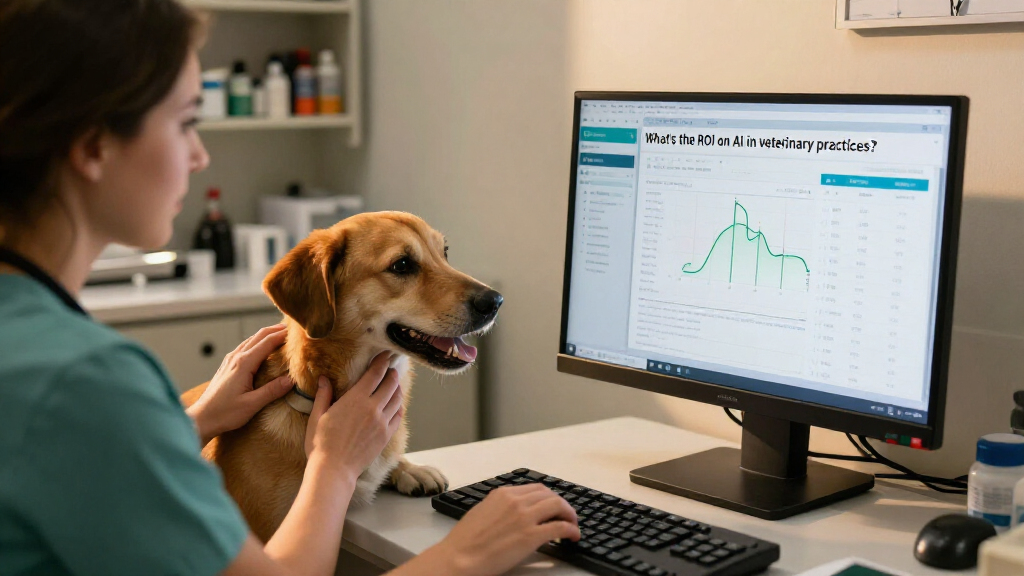
What is the ROI on AI in veterinary practices?
The report gives no single ROI figure. It says returns depend on the tool, the clinic’s goals, staff use and the measures recorded before and after adoption.
Which veterinary workflows may benefit from AI?
The report highlights clinical documentation, diagnostic decision support and client communication. It describes possible time or workflow benefits, not guaranteed financial results.
What should a practice measure before adopting AI?
Choose measures tied to the intended use. Examples include chart-completion time and after-hours charting for documentation tools, or no-show rates, reminder responses and call time for communication tools.
How long should a clinic collect baseline data?
The report recommends collecting relevant baseline numbers for two to four weeks before implementing an AI tool.
Does the report prove AI saves money for every clinic?
No. It offers an individual veterinarian’s account and practical measurement suggestions, but no industry-wide financial study or guarantee that every practice will see a return.
Source: rss
Fall Picks
fall essentials
As an affiliate, we earn on qualifying purchases.