
If you’re searching for homemade dog food recipes, the biggest challenge isn’t finding recipes — it’s finding recipes that are actually nutritionally complete. Many popular books read like comfort-food collections for dogs, which is fine as an occasional topper but risky as a daily diet. My top pick is The Science-Based Homemade Dog Food Cookbook, because it treats nutrient balance as the foundation rather than an afterthought. The Forever Dog Life stands out for owners who want a longevity-focused lifestyle approach, while the Homemade Dog Food Chart Book wins on practical value with its 28-day meal plan and toxic-food chart. The main tradeoff across this category is scientific rigor versus convenience: the more precise the nutrition guidance, the more time and ingredient sourcing the recipes demand. Keep reading for the full breakdown of all 13 books.

Get pet supplies delivered free — and shop member deals
- Fast, free delivery on millions of items
- Access to Prime Big Deal Days deals on October 6–7
- Prime Video, Amazon Music and more included
Complete the kit


Key Takeaways
- Only a minority of these books provide actual nutrient-balancing guidance (portion ratios, supplementation schedules); most assume you’ll consult a vet separately, which separates the top picks from the rest.
- Time-saving claims vary widely — one book delivers genuine 15-minute recipes while others labeled ‘easy‘ still require batch prep and multi-step cooking.
- Condition-specific books (pancreatitis, small breed, allergies) outperform general cookbooks for targeted needs but are too narrow to serve as an all-purpose kitchen reference.
- Several books include printable charts and meal planners, which turned out to matter more for long-term consistency than recipe count.
- Recipe quantity was a poor predictor of quality: the 120+ recipe books included more filler, while tighter books around 50-75 recipes were easier to actually cook from weekly.




| homemade dog food recipe | Format |
|---|---|
| Easy-to-Make Homemade Healthy | Cookbook |
| The Authentic Homemade Dog Foo | Cookbook |
| The Easiest Vet-Approved Homem | Cookbook |
| The Small Breed Dog Food Cookb | Cookbook |
| Homemade Dog Food Recipes: A P | Cookbook |
| Easy Homemade Dog Food Cookboo | Cookbook |
| Home Cooking for Your Dog: 75 | Cookbook |
| Homemade Dog Food Chart Book: | Book |
| Homemade Dog Food Cookbook: Nu | Cookbook |
| The Science-Based Homemade Dog | Cookbook |
| The Authentic Homemade Dog Tre | Cookbook |
| The Forever Dog Life: 120+ Rec | Dog care guide and cookbook |
| Homemade Dog Food Cookbook for | — |
More Details on Our Top Picks
Easy-to-Make Homemade Healthy Dog Food Cookbook
Easy-to-Make Homemade Healthy Dog Food Cookbook earns the top spot because it covers the full cycle of homemade feeding — recipe ideas, preparation, and storage — without narrowing its audience. Where The Small Breed Dog Food Cookbook locks you into one dog size and Homemade Dog Food Recipes: A Practical Guide to Healthy Meals skips nutritional depth entirely, this option balances accessibility with genuinely useful kitchen guidance. The storage advice is the differentiator: batch cooking only saves time if you know how to keep food safe, and most competitor cookbooks ignore that step. This pick makes the most sense for a first-time home cook who wants one book to grow with rather than a niche title to outgrow.
Pros:- Covers the complete workflow from cooking to storing leftovers
- Broad, size-agnostic recipes suitable for multi-dog households
- Beginner-friendly structure that doesn’t assume prior nutritional knowledge
- Balanced-nutrition focus rather than just meal ideas
Cons:- Lacks the veterinary endorsement claims of competing titles
- No specialized chapters for allergies, pancreatitis, or breed-specific needs
Best for: First-time homemade dog food cooks who want one general-purpose book covering recipes, prep, and storage
Not ideal for: Owners of dogs with allergies or specific conditions, who will get more targeted recipes from a specialist title like The Authentic Homemade Dog Food Cookbook
- Format:Cookbook
- Recipe Focus:Balanced, nutritious homemade meals
- Target Audience:General — dogs of all sizes
- Special Features:Preparation and storage guidance
- Vet Approval:Not specified
- Allergy Recipes:Not specified
Our verdict“Buy this if you want a single, well-rounded starter cookbook that goes beyond recipes into practical meal management.”
The Authentic Homemade Dog Food Cookbook: Vet-Approved, Nutritious Allergy-Friendly Recipes for Dogs of All Sizes
For anyone cooking because their dog reacts to commercial formulas, this title stands apart by making allergy-friendly recipes the core of the book rather than an afterthought. Compared with Easy-to-Make Homemade Healthy Dog Food Cookbook, which serves general feeders, this one pairs its vet-approved recipes with a feeding guide scaled to dogs of all sizes — the piece most owners get wrong when they switch from kibble with printed portion charts. The tradeoff is that allergy-focused cooking demands more label discipline and ingredient sourcing than casual home cooking, so it’s a bigger lifestyle commitment than the budget-minded Homemade Dog Food Recipes guide.
Pros:- Allergy-friendly recipes built in as a core feature
- Vet-approved formulation claims add reassurance
- Feeding guide covers dogs of all sizes
- Works for households with multiple dogs of different breeds
Cons:- Allergy-friendly ingredients tend to cost more than standard recipes
- No stated quick-prep angle, so meals take longer than 15-minute alternatives
Best for: Owners of dogs with food sensitivities or allergies who need vet-approved recipes they can trust
Not ideal for: Casual cooks wanting cheap, simple meal ideas — the allergy focus adds ingredient cost and sourcing effort they won’t use
- Format:Cookbook
- Target Audience:Dogs of all sizes
- Vet Approval:Yes, described as vet-approved
- Recipe Type:Nutritious and allergy-friendly
- Included Guidance:Comprehensive feeding guide by dog size
- Preparation Focus:Standard home cooking
Our verdict“This is the pick for allergy-driven home cooking, provided you accept pricier ingredient lists.”
The Easiest Vet-Approved Homemade Dog Food Cookbook: Healthy & Allergy-Friendly Recipes in 15 Minutes
The 15-minute prep promise is what separates this book from every other vet-approved option here — it directly attacks the number one reason people abandon homemade dog food: time. Compared with The Authentic Homemade Dog Food Cookbook, it matches the vet-approved and allergy-friendly claims but adds portion and dosage management guidance, which matters when you’re replacing measured kibble with scoop-and-serve home cooking. Compared with Homemade Dog Food Recipes: A Practical Guide, the veterinary backing makes it the safer choice for dogs with health concerns. The honest tradeoff: even 15-minute recipes still mean cooking several times a week, so this eases the burden rather than eliminating it.
Pros:- 15-minute recipes fit into weeknight routines
- Vet-approved and allergy-friendly in one package
- Detailed portion management guidance prevents overfeeding
- Explicitly framed around long-term canine health
Cons:- Still requires real cooking time versus scooping commercial food
- Speed-focused recipes may limit variety compared with longer-form cookbooks
Best for: Time-pressed owners who want vet-approved homemade meals without long kitchen sessions
Not ideal for: Owners seeking a low-cost meal plan — quick recipes with allergy-friendly ingredients rarely come cheap, unlike budget-focused alternatives
- Format:Cookbook
- Preparation Time:15 minutes per recipe
- Vet Approval:Yes
- Recipe Type:Healthy, allergy-friendly
- Included Guidance:Food dosage and portion management
- Health Focus:Long-term canine health support
Our verdict“If a busy schedule has stopped you from cooking for your dog, this is the book designed to remove that excuse.”
The Small Breed Dog Food Cookbook: Healthy & Safe Vet-Approved Homemade Recipes to Ensure Proper Nutrition, Improve Digestion, and Support Your Small Dog’s Well-Being
Small dogs aren’t just smaller portions — they have different caloric density and digestive needs, which is why a general title like Easy-to-Make Homemade Healthy Dog Food Cookbook can leave gaps for Chihuahua and Dachshund owners. This book targets that problem directly with vet-approved recipes built around digestion and small-dog nutrition, something none of the all-sizes cookbooks in this roundup attempt. The digestive health focus is a real differentiator, since small breeds are prone to sensitive stomachs. The limitation is obvious: if you also have a large dog, you’ll need a second book, and the recipes still require veterinary consultation to fine-tune for individual conditions.
Pros:- Recipes tailored specifically to small breed nutritional needs
- Vet-approved for added confidence
- Digestive health is a central focus, not a footnote
- Well-being framed holistically, including safety guidance
Cons:- Useless for owners of medium or large dogs
- Still requires vet consultation to balance an individual dog’s needs
- Time and meal-prep commitment exceeds commercial food
Best for: Small breed owners dealing with picky eating or digestive sensitivity who want size-specific recipes
Not ideal for: Multi-dog households with large breeds — this book covers only one end of the size spectrum
- Format:Cookbook
- Target Audience:Small breed dog owners
- Vet Approval:Yes
- Recipe Focus:Proper nutrition and improved digestion
- Health Focus:Small dog well-being and safety
- Dog Sizes Covered:Small breeds only
Our verdict“A specialist pick worth choosing over general cookbooks if your dog is under 25 pounds and digestion is a concern.”
Homemade Dog Food Recipes: A Practical Guide to Healthy Meals
Among these cookbooks, this is the one that treats cost as a design constraint rather than an afterthought. Where The Easiest Vet-Approved Homemade Dog Food Cookbook justifies convenience and The Authentic Homemade Dog Food Cookbook targets allergy management, this guide aims at owners whose primary motivation is feeding well without a premium grocery bill. The quick, easy recipes lower the entry barrier for first-time cooks. The honest weakness is depth: the available material offers no specific nutritional detail, so anyone managing a health condition — allergies, pancreatitis, sensitive digestion — should step up to a vet-approved title. This option works best as an entry point, not a clinical resource.
Pros:- Budget-conscious approach keeps ingredient costs down
- Quick and easy recipes suit beginners
- Well-being-focused meal philosophy
- Low-risk way to sample homemade feeding before committing
Cons:- No stated veterinary approval or nutritional credentials
- Lacks the portion and feeding guides competitors include
- Not suitable as a sole resource for dogs with health issues
Best for: Cost-conscious owners who want to try homemade dog food without investing in premium ingredients or a specialist book
Not ideal for: Owners of dogs with medical or dietary conditions who need vet-approved, nutritionally precise recipes
- Format:Cookbook
- Recipe Focus:Quick, easy, healthy meals
- Vet Approval:Not specified
- Target Audience:Cost-conscious dog owners and beginners
- Special Guidance:Not specified
Our verdict“Pick this to test homemade dog food on a budget, then upgrade to a vet-approved title if your dog has specific needs.”
Easy Homemade Dog Food Cookbook
This option stands out for sheer recipe volume and planning support: 130 recipes plus a 30-day meal plan broken down by dog size and breed. Compared with Home Cooking for Your Dog, which offers 75 holistic recipes but no structured calendar, this pick makes more sense for owners who freeze up when deciding what to cook next week. The plan does the scheduling work for you, which is where most homemade diets actually fall apart. The tradeoff is that breadth can come at the cost of depth — with 130 recipes, expect more simple repeats and rotation-style variations rather than 130 wholly distinct formulations. It also does not emphasize allergy-specific or veterinary-nutrition detail the way Nutrient Balance Made Easy does.
Pros:- 130 recipes offer extensive variety and rotation options
- 30-day meal plan removes daily decision-making
- Portion guidance covers different sizes and breeds
Cons:- Broad recipe count may mean less nutritional depth per recipe
- Limited allergy and special-diet focus compared to dedicated titles
Best for: Busy owners who want a pre-built cooking calendar and lots of variety across multiple dogs or sizes
Not ideal for: Owners of dogs with food allergies or medical conditions who need targeted, vet-guided formulations
- Recipes:130
- Meal plan:30 days
- Suitable for:Dogs of every size and breed
- Format:Cookbook
- Approach:Planned rotation cooking
Our verdict“This is the pick for owners who want homemade dog food handed to them as a ready-to-follow schedule rather than a project they have to design themselves.”
Home Cooking for Your Dog: 75 Holistic Recipes for a Healthier Dog
Where the Easy Homemade Dog Food Cookbook competes on volume, this title competes on philosophy. Its 75 recipes sit inside a holistic framework that treats home cooking as long-term wellness support, not just meal prep. This pick makes the most sense for owners who already buy into whole-food, natural-ingredient thinking and want a book that explains the reasoning, not just the steps. The tradeoff is practicality: 75 recipes is roughly half the selection of volume-focused competitors, and there is no structured multi-week meal plan like the 28-day or 30-day calendars elsewhere in this roundup. Owners who want day-by-day guidance will find themselves doing more of their own planning.
Pros:- Holistic approach explains why ingredients support health
- 75 curated recipes rather than padded repetition
- Wellness-oriented framing supports long-term feeding habits
Cons:- Smaller recipe selection than volume-focused alternatives
- No structured meal plan, so daily planning falls on the owner
Best for: Whole-food-minded owners who value the reasoning behind recipes and long-term wellness framing
Not ideal for: Beginners who need a step-by-step meal calendar and maximum recipe variety to stay motivated
- Recipe count:75
- Approach:Holistic home cooking
- Focus:Health-supporting home-cooked meals
- Format:Cookbook
- Meal plan:None included
Our verdict“Choose this if you see homemade dog food as a lifestyle and want a book that teaches the philosophy, not one that simply schedules dinner.”
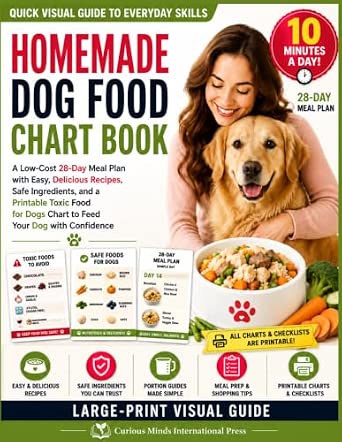
Homemade Dog Food Chart Book: 28-Day Low-Cost Meal Plan with Easy Recipes, Safe Ingredients, and Printable Toxic Food Chart
This option stands out as the most beginner- and wallet-friendly entry in the lineup. Its 28-day low-cost meal plan pairs simple recipes with a printable toxic food chart — a safety reference that no other title here matches, and one that genuinely matters for first-time cooks who don’t yet know which pantry staples are dangerous to dogs. Compared with the Easy Homemade Dog Food Cookbook, the plan is shorter and the recipe range narrower, but the budget framing means ingredient lists lean on affordable staples. The real drawback: a low-cost plan cannot cover every micronutrient need on its own, and owners will likely need to research or add supplements to make the diet nutritionally complete — something the science-based titles handle more directly.
Pros:- Budget-focused plan keeps grocery costs predictable
- Printable toxic food chart adds genuine safety value for beginners
- Easy recipes suit first-time home cooks
Cons:- Likely requires supplement research for complete canine nutrition
- 28-day plan offers less long-term variety than larger cookbooks
Best for: Cost-conscious first-timers who want an easy entry point plus a quick-reference safety chart
Not ideal for: Owners seeking a nutritionally complete, professionally balanced program without additional supplement research
- Format:Book
- Meal plan length:28 days
- Includes:Printable toxic food chart
- Approach:Low-cost, easy recipes
- Best use:Budget meal planning for beginners
Our verdict“The cheapest, safest on-ramp to homemade dog food — just plan to build on it with nutritional supplements once you’ve found your footing.”
Homemade Dog Food Cookbook: Nutrient Balance Made Easy
This pick carves out the allergy and life-stage niche better than anything else in this batch. Its recipes are positioned as vet-approved and allergy-friendly, with coverage spanning puppies through seniors — a range that the 28-Day Chart Book and its budget-first approach simply don’t address. For households with an itchy, food-sensitive dog, that focus is worth more than raw recipe counts; a generic 130-recipe book is far less useful if half the ingredients trigger a reaction. The honest tradeoff is verifiability: the listing provides little detail on recipe depth or supplementation guidance, so buyers are trusting the vet-approved framing without seeing sample formulations. Owners with a veterinary nutritionist already involved may also find it overlaps with guidance they already have.
Pros:- Allergy-friendly recipes address a common and frustrating problem
- Vet-approved framing supports balanced nutrition
- Covers every life stage from puppy to senior
- Targets digestion and healthy weight, not just meals
Cons:- Sparse product detail makes recipe depth hard to verify before buying
- May duplicate guidance owners already receive from their veterinarian
Best for: Owners of allergy-prone dogs, or multi-dog households spanning puppy to senior life stages
Not ideal for: Owners already working with a vet nutritionist who need deeper formulation data than a general cookbook provides
- Format:Cookbook
- Recipe type:Vet-approved, allergy-friendly
- Target audience:Dogs at all life stages
- Focus areas:Balanced nutrition, digestion, healthy weight
- Special diets:Allergy-friendly formulations
Our verdict“If food allergies are the reason you’re cooking at home, this is the most targeted option in the lineup despite its thin listing details.”
The Science-Based Homemade Dog Food Cookbook
Among all the picks here, this title leans hardest on nutritional compliance, presenting its recipes as vet-approved and AAFCO-compliant. That distinction matters: AAFCO compliance signals recipes are formulated against recognized nutrient profiles, which the Homemade Dog Food Chart Book concedes it may not fully deliver. This pick makes the most sense for analytical owners — the type who want to know their homemade meals meet the same standard as commercial food rather than crossing their fingers. The tradeoff is trust but not proof: the listing offers no sample recipes or detailed content to verify the compliance claims, and science-first framing can read drier than the lifestyle-oriented Home Cooking for Your Dog for owners who want encouragement alongside data.
Pros:- AAFCO-compliant framing signals serious nutritional standards
- Vet-approved positioning across all recipes
- Covers dogs of every age, breed, and size
Cons:- Claims are difficult to verify without sample content or detailed listings
- Technical tone may feel dry compared to lifestyle-focused alternatives
Best for: Detail-driven owners who want homemade meals built to recognized nutritional standards
Not ideal for: Casual cooks who prefer an encouraging, lifestyle-style tone over technical formulation language
- Format:Cookbook
- Recipes:Homemade dog food recipes
- Compliance:Described as AAFCO-compliant
- Intended for:Dogs of every age, breed, and size
- Approach:Science-based formulation
- Positioning:Vet-approved
Our verdict“For owners who won’t trust a bowl they can’t measure against a standard, this is the most compliance-oriented choice — provided the claims hold up on inspection.”
The Authentic Homemade Dog Treats Cookbook: Nutritious, Allergy and Dental-Friendly Recipes With Pantry Staples For Puppies to Seniors
Every other title in this roundup focuses on full meals, which makes this one the natural companion pick rather than a standalone solution. Where The Science-Based Homemade Dog Food Cookbook targets balanced daily bowls, this book zero in on the smaller category most owners overlook: treats that don’t undo a careful diet. The recipes lean on common pantry staples, so there is no hunting for specialty flours or exotic proteins mid-recipe. Its dental-friendly focus is genuinely useful for small breeds and seniors prone to tartar, and the allergy-friendly framing means the recipes avoid the usual chicken-and-wheat triggers. The tradeoff is real, though: this will not replace a meal cookbook, and compared with The Forever Dog Life, it offers far less nutritional context for why each recipe works.
Pros:- Recipes rely on pantry staples already in most kitchens
- Allergy-friendly formulations avoid common triggers
- Dental-friendly recipes suit seniors and small breeds
- Covers every life stage from puppy to senior
Cons:- Treats only — cannot serve as a primary meal resource
- Provides little scientific or veterinary context compared with more rigorous titles
Best for: Owners already cooking balanced meals who want healthy, budget-friendly treats and training rewards for allergy-prone or dental-sensitive dogs
Not ideal for: Anyone seeking a complete meal-planning resource — this covers treats only and will leave daily nutrition questions unanswered
- Format:Cookbook
- Recipe Focus:Allergy-friendly, dental-friendly dog treats
- Suitable For:Puppies to senior dogs
- Ingredients:Common pantry staples
- Series:Healthy Homemade Dog Food Cookbook Series
- Dietary Focus:Allergy-friendly
Our verdict“A smart add-on for owners who already cook their dog’s meals and want safe, simple treats that support dental and allergy needs.”
The Forever Dog Life: 120+ Recipes, Longevity Tips, and New Science for Better Bowls and Healthier Homes
This is the most ambitious book in the lineup — it treats homemade dog food as one piece of a larger longevity puzzle rather than a recipe collection. Compared with the Easy Homemade Dog Food Cookbook, which keeps things simple and meal-focused, this volume layers in 120+ recipes plus longevity science and home-environment guidance, making it closer to a lifestyle reference than a kitchen manual. That depth is its selling point: readers learn not just what to cook but why ingredients, routines, and household choices affect lifespan. The flip side is commitment. Recipes here tend to assume more prep time and ingredient sourcing than the 15-minute approach of The Easiest Vet-Approved Homemade Dog Food Cookbook, so busy owners may find themselves bookmarking rather than cooking.
Pros:- More than 120 recipes with wide variety
- Longevity tips grounded in current science
- Covers home environment, not just food
- Doubles as a lasting reference rather than a one-read cookbook
Cons:- Heavier time and ingredient investment than quick-prep cookbooks
- Broader scope means less step-by-step hand-holding for pure beginners
Best for: Dedicated owners who want a long-term canine wellness reference, not just recipes, and are willing to invest time in deeper prep
Not ideal for: Time-pressed cooks who need quick weekday meals — the scope and prep expectations exceed quick-and-simple needs
- Format:Dog care guide and cookbook
- Recipe Count:120+
- Special Features:Longevity tips and science-based guidance
- Coverage:Meals and healthier home environments
- Focus:Canine longevity and daily nutrition
- Audience:Dedicated long-term dog owners
Our verdict“The pick for owners who see homemade food as part of a lifelong health plan and want science-backed depth over convenience.”
Homemade Dog Food Cookbook for Pancreatitis
Most cookbooks in this roundup assume a healthy dog; this one does not. Built entirely around low-fat recipes for dogs with pancreatitis, it fills a gap that generalist titles like Home Cooking for Your Dog leave open — those books may be holistic, but they are not designed around a fat-restricted medical diet. The structure here is practical: ready-made meal plans, simple recipes, and ingredient safety guidance that remove guesswork for owners managing a condition where a dietary mistake carries real consequences. The tradeoff is narrowness. If your dog does not have pancreatitis or a similar low-fat requirement, much of this book will sit unused, and compared with The Forever Dog Life it offers no broader wellness or longevity content. It is a tool, not a library.
Pros:- Purpose-built low-fat recipes for a specific medical need
- Practical meal plans reduce daily decision fatigue
- Ingredient safety guidance helps owners avoid harmful foods
- Everyday nutrition info supports long-term condition management
Cons:- Extremely narrow scope beyond pancreatitis management
- Should complement, not replace, veterinary dietary supervision
Best for: Owners of dogs diagnosed with pancreatitis who need vet-adjacent low-fat recipes, portion guidance, and ingredient safety lists
Not ideal for: Healthy dogs or multi-dog households without fat restrictions — the strict dietary lens makes most recipes unnecessarily limited
- Content Type:Cookbook
- Diet Focus:Low-fat recipes for dogs with pancreatitis
- Includes:Recipes and meal plans
- Guidance:Ingredient safety and everyday nutrition
- Recipe Style:Easy low-fat preparation
- Intended Use:Medical dietary management
Our verdict“A targeted, practical resource for owners managing canine pancreatitis who need dependable low-fat meals without improvisation.”

How We Picked
I evaluated each book against four criteria that matter most to someone cooking for their dog. First, nutritional credibility: whether recipes are vet-reviewed, include balance guidance (calcium-to-phosphorus ratios, vitamin and mineral supplementation), or at minimum direct you to proper supplementation. Second, practicality: ingredient accessibility, prep time, batch-cooking feasibility, and whether a normal weeknight cook could realistically follow along. Third, audience fit: a first-time home cook needs different things than someone managing pancreatitis or allergies, so I judged each book against the reader it claims to serve. Fourth, usability as a working kitchen reference — meal planners, portion charts, feeding guidelines, and indexing all affected how often a book would actually get opened.
The ranking prioritizes books that can safely serve as a primary daily-diet resource over casual recipe collections. General-purpose books that treat home cooking as a complete feeding strategy ranked higher than those positioning it as occasional treats or toppers, while specialty books were judged on how well they execute their specific promise rather than compared head-to-head with generalists.
| homemade dog food recipe | Format |
|---|---|
| Easy-to-Make Homemade Healthy | Cookbook |
| The Authentic Homemade Dog Foo | Cookbook |
| The Easiest Vet-Approved Homem | Cookbook |
| The Small Breed Dog Food Cookb | Cookbook |
| Homemade Dog Food Recipes: A P | Cookbook |
| Easy Homemade Dog Food Cookboo | Cookbook |
| Home Cooking for Your Dog: 75 | Cookbook |
| Homemade Dog Food Chart Book: | Book |
| Homemade Dog Food Cookbook: Nu | Cookbook |
| The Science-Based Homemade Dog | Cookbook |
| The Authentic Homemade Dog Tre | Cookbook |
| The Forever Dog Life: 120+ Rec | Dog care guide and cookbook |
| Homemade Dog Food Cookbook for | — |
Factors to Consider When Choosing Homemade Dog Food Recipes
Before picking a homemade dog food recipe book, it helps to understand what separates a safe daily-diet resource from a recipe collection that could quietly create nutritional gaps over months of feeding.Vet Involvement and Nutritional Completeness
The single most expensive mistake in home-cooked dog food is assuming that fresh, whole ingredients equal balanced nutrition. Dogs have specific requirements for calcium, certain vitamins, and trace minerals that home kitchens don’t naturally supply — a chicken-and-rice recipe, however wholesome, is deficient in calcium without added supplementation. Look for books that either include vet review or formulation credentials, or that explicitly tell you which supplements to add and in what amounts. A book that never mentions calcium supplementation is a red flag regardless of how appealing its recipes look. This is also where price matters least: an inexpensive book with sound formulation guidance beats an expensive coffee-table cookbook with none.
Match the Book to Why You’re Cooking
Buyers arrive at homemade dog food from very different starting points — a picky eater, a diagnosed allergy, pancreatitis, or a general desire for fresher meals — and the right book depends heavily on which one describes you. Generalist cookbooks serve the curious cook well but rarely go deep enough for medical diets, where fat content and ingredient exclusions need precision. Conversely, condition-specific books can be dangerously narrow if you try to stretch them beyond their purpose. Before buying, write down your actual reason for switching; if it involves a diagnosed condition, get your vet’s input on the book’s approach before committing to it. If it’s general wellness, you have far more flexibility and can prioritize convenience and recipe variety.
Realistic Time and Ingredient Commitment
Recipe books consistently overestimate how much cooking people will do, and abandoned home-cooking plans usually fail on logistics, not motivation. When comparing books, look past the recipe count and check whether ingredients are pantry staples or specialty items, whether recipes scale for batch cooking and freezing, and whether the stated prep times reflect real weeknight cooking. Books with meal planners and shopping lists tend to survive contact with a busy schedule better than pure recipe collections. If you work long hours, a book built around 30-minute one-pot meals and freezer-friendly batches will get used; one requiring daily fresh preparation will not, no matter how good the recipes are.
Safety Information Beyond the Recipes
A quality cookbook teaches you what not to feed, and this varies more between books than most buyers expect. The best resources include toxic-food reference charts, guidance on portion sizes by weight and life stage, and transition protocols for moving your dog off kibble without stomach upset. Books that skip safety sections leave you dependent on internet searches every time you want to substitute an ingredient. Printable or wall-mountable charts are genuinely useful here, not a gimmick — they end up on the fridge and get consulted constantly. Treat the absence of a toxic-foods section as a signal that the book was written for entertainment more than daily feeding.
Life Stage and Size Specificity
Puppies, seniors, small breeds, and large breeds have meaningfully different caloric density and nutrient needs, and most general cookbooks paper over this with a single feeding chart. A Maltese and a Great Dane cannot eat the same recipes scaled by volume — kibble-per-calorie density and calcium levels for growing puppies are particular trouble spots. Check whether a book addresses your dog’s life stage explicitly rather than implying one-size-fits-all. Small-breed owners benefit from books with portion guidance for dogs under 20 pounds, where standard recipes produce awkward leftover quantities. If you have a puppy, be stricter still: growth-stage homemade diets carry the highest nutritional risk of any home-cooking scenario.
Recipe Volume Versus Recipes You’ll Actually Use
Big recipe counts sell books but rarely determine value. Most home cooks settle into a rotation of eight to twelve recipes within a couple of months, so a book with 60 well-tested, repeatable recipes often outperforms one with 150 including many novelty bakes. Look at how many recipes match proteins your dog tolerates and cooking methods you enjoy. Variety still matters — it prevents boredom for picky dogs and ingredient fatigue for you — but beyond a workable rotation, extra recipes are padding. When comparing two books, count the recipes you’d genuinely cook, not the number on the cover.
Frequently Asked Questions
Is a homemade diet actually nutritionally complete, or do I always need supplements?
Almost every properly formulated homemade dog food diet requires supplementation, because ordinary kitchen ingredients can’t deliver enough calcium, vitamin D, and certain trace minerals in the right ratios. The difference between books is whether they tell you this clearly and specify amounts, or leave you to figure it out. Books formulated or reviewed by veterinarians typically include a supplement schedule per recipe or per calorie level, which is the safest approach. If a book claims its recipes are complete without supplements, treat that claim with real skepticism and confirm with your vet before feeding it long-term. Bone meal or a balanced canine vitamin/mineral blend is standard practice in well-designed plans.
Should I talk to my vet before switching my dog to homemade food?
Yes, especially if your dog is a puppy, senior, pregnant, or managing any health condition. A vet can review the book’s approach, flag recipes inappropriate for your dog’s condition, and often run bloodwork before and a few months after the switch to catch deficiencies early. For healthy adult dogs, a veterinary consultation is still worthwhile but a board-certified veterinary nutritionist is the gold standard if you plan to feed homemade food exclusively. Bringing the specific book to the appointment is more productive than asking general questions — your vet can point out which chapters to rely on and which to skip. This step costs far less than correcting a deficiency later.
How do I transition my dog from kibble to homemade food without stomach problems?
The standard approach is a gradual shift over seven to ten days, starting with roughly 25% homemade food mixed into the current diet and increasing the proportion every two or three days. Sudden diet changes commonly cause diarrhea and gas regardless of how healthy the new food is, because gut bacteria need time to adapt. Some books include transition protocols in their early chapters, and those are worth prioritizing if this is your first switch. Watch stool quality and appetite during the change and slow down if things loosen. Dogs with sensitive stomachs may need two to three weeks rather than one.
Is homemade dog food cheaper than premium kibble or fresh commercial food?
It can be, but the savings depend entirely on your ingredient choices and where you shop. Cooking with budget-friendly proteins like chicken, turkey, eggs, and seasonal vegetables often beats premium fresh delivery services on cost per meal, though it usually costs more than standard kibble. Batch cooking and buying proteins on sale in bulk is where the real savings appear — one book in this roundup is built specifically around a low-cost monthly plan. Factor in supplements, which add a fixed cost per meal regardless of how cheap your ingredients are. If budget is your primary motivation, look for books that include cost-per-serving estimates and budget shopping guidance rather than gourmet recipes.
Can I use one homemade food book for multiple dogs with different needs?
You can, but only if the book includes portion and adjustment guidance for different weights, ages, and activity levels — several generalist books do this well with feeding charts. The trouble starts when one dog has a medical restriction like pancreatitis or allergies, because condition-specific modifications affect the whole recipe, not just the portion. In multi-dog households with one special-needs dog, many owners cook a single base recipe and adjust add-ons per dog, which works if the book explains how to do it safely. If your dogs’ needs diverge sharply — say a growing puppy and a senior with kidney concerns — you may genuinely need two resources. Be honest about this before buying, because the wrong single book leads to unsafe compromises.
Conclusion
For most owners, The Science-Based Homemade Dog Food Cookbook is the best overall choice because it solves the category’s central problem — nutritional completeness — without making the cooking intimidating. If budget drives your decision, the Homemade Dog Food Chart Book delivers the best value with its 28-day low-cost plan and printable safety charts, making it the smartest entry point for anyone testing whether home cooking fits their routine. On the premium end, The Forever Dog Life earns its place for owners who want more than recipes — its longevity science and whole-home approach justify the higher investment for committed readers.
Beginners who feel overwhelmed should start with The Easiest Vet-Approved Homemade Dog Food Cookbook, whose 15-minute recipes lower the barrier to a first week of cooking. For specific needs, the paths are clear: The Authentic Homemade Dog Food Cookbook for allergy management, the Homemade Dog Food Cookbook for Pancreatitis for that condition, the Small Breed Dog Food Cookbook for dogs under 20 pounds, and Home Cooking for Your Dog for holistic-minded owners. Whatever you choose, pair the book with a vet conversation before switching fully — the best cookbook is the one you cook from consistently, safely, and with professional backup.
Fall Picks
fall essentials
As an affiliate, we earn on qualifying purchases.