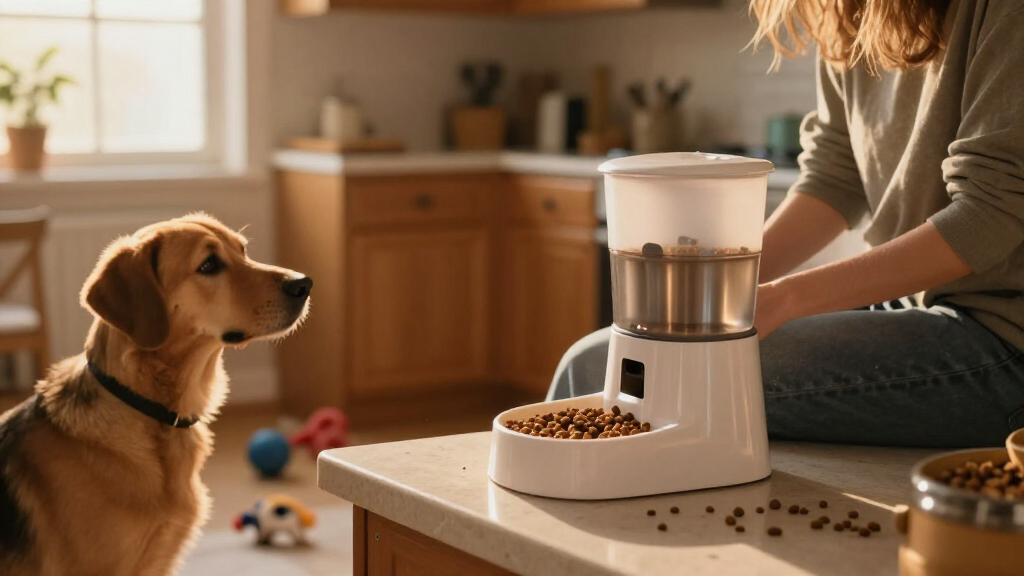

The right automatic pet feeder depends on one question before anything else: does your pet eat dry food, wet food, or both? The PETLIBRO WiFi Automatic Feeder (5L) earns my best overall pick for combining reliable timed dispensing with app control and freshness preservation at a mid-range price. The Petivity Smart Feeder with facial recognition stands out for multi-pet homes where one cat keeps stealing the other’s meals, while the VOLUAS 4L feeder is the value choice if you just want dependable scheduling without smart features. The category’s biggest tradeoffs are between dry-only versus wet-food refrigeration, smart app features versus simple button programming, and capacity versus countertop footprint. Keep reading for the full breakdown, including dual-pet feeders, camera-equipped models, and gravity sets that require no power at all.

Get pet supplies delivered free — and shop member deals
- Fast, free delivery on millions of items
- Access to Prime Big Deal Days deals on October 6–7
- Prime Video, Amazon Music and more included
Complete the kit


Key Takeaways
- Smart features create a real split in this lineup: WiFi feeders like the PETLIBRO 5L and Petivity cost more but let you adjust meals remotely, while button-controlled models like the VOLUAS and Whiskmiel trade that flexibility for simplicity and lower prices.
- Only one feeder here (the refrigerated wet food model with ice packs) handles wet food safely — every other pick is dry-kibble only, so wet-food feeders are a category of their own and cost the tradeoff of tiny meal capacity.
- Facial recognition (Petivity) and AI detection (PETLIBRO for 2 Cats) solve food theft between pets, which ordinary dual-bowl feeders like the Dual 4.2L model cannot prevent once food is already dispensed.
- Battery backup matters more than buyers expect: feeders that run on AC with battery support (the 8L LCD model, PETLIBRO) keep feeding through power outages, while gravity sets work with no electricity at all but can’t portion control.
- Capacity ranged from 3L to 8L in this roundup, but bigger isn’t always better — large storage means food sits longer and goes stale unless the feeder has a sealed ring or desiccant system like the ANDOLL and PETLIBRO models.


| automatic pet feeder | Capacity |
|---|---|
| Automatic Cat Feeder with 3L C | 3L (12 cups) |
| Automatic Wet Food Cat Feeder | — |
| ANDOLL HOME Automatic Cat Feed | 4L |
| PETLIBRO Automatic Cat and Dog | 5 liters |
| VOLUAS Automatic Cat Feeder | 4L / 16.9 cups |
| Petivity Smart Cat Feeder with | — |
| Automatic Dog and Cat Feeder | 8L / 34 cups |
| PETLIBRO Automatic Cat Feeder | — |
| Dual Automatic Cat Feeder for | 4.2L |
| Whiskmiel 5L Automatic Cat Fee | — |
| iPettie FW54 5G/2.4GHz WiFi Au | — |
| Automatic Dog Feeder | — |
| Frienhund Automatic Cat Feeder | 7L (29 Cups) |
| Oneisall Automatic Cat Feeder | 5L / 20 Cups |
More Details on Our Top Picks
Automatic Cat Feeder with 3L Capacity, Timed Dosing, and Stainless Steel Bowl
Simple scheduling at a low price is what this feeder delivers, and it does so without asking you to wrestle with an app. The 1-6 meal programming with adjustable portions covers the basics well, and the stainless steel bowl is a genuine step up from the plastic trays on many budget models. Compared with the PETLIBRO WiFi feeder, you give up remote control and smart alerts — everything here happens on a basic LCD panel — but you also skip the setup headaches and Wi-Fi dependency entirely. The anti-jam dispensing and desiccant-sealed lid keep kibble flowing and fresh, which is more than I’d expect at this price. The real tradeoff is power: three D-size batteries aren’t included, and while battery life runs past 180 days, stocking them adds hidden cost. Capacity is also modest next to the VOLUAS 4L model, so plan on refills if you free-feed a larger cat.
Pros:- Schedules 1-6 meals per day with customizable portions
- Stainless steel bowl is hygienic and easy to clean
- Desiccant and sealing lid keep kibble fresh
- Locking design stops clever cats from raiding the hopper
Cons:- Batteries (3 D-cell) not included, adding to the true cost
- No WiFi or app control — manual LCD programming only
- 3L capacity means frequent refills for multi-pet households
Best for: Budget-conscious cat owners who want reliable scheduled dry-food feeding without app complexity
Not ideal for: Owners who travel often and want remote monitoring — there’s no WiFi, camera, or phone notification here
- Capacity:3L (12 cups)
- Meals per Day:1-6 scheduled meals
- Power:3 D-size batteries (not included) or wall adapter
- Battery Life:Over 180 days
- Food Size Range:2-15mm kibble
- Bowl Material:Stainless steel
- Connectivity:None — LCD panel programming
Our verdict“A solid, low-friction choice for single-cat households that value dependable scheduling over smart features.”
Automatic Wet Food Cat Feeder with Refrigeration and Ice Packs for Small Pets
Almost every feeder in this roundup — including the PETLIBRO 5L and VOLUAS 4L — handles dry kibble only, which makes this wet-food model a genuine rarity. Four 240mL compartments rotate open on a timer, and two frozen ice packs keep chilled food safe for up to eight hours. That solves a problem no kibble hopper can: medicated or canned meals while you’re at work. Because it runs on AA batteries with no cords or WiFi, it works on a countertop, in a sunroom, or anywhere an outlet isn’t handy — a flexibility the corded ANDOLL HOME can’t match. The compromises are real, though: eight hours of freshness means it covers a workday, not an overnight trip, and you must remember to freeze the packs ahead of time. Capacity also limits it to small pets, so large-breed dog owners should look elsewhere in this guide.
Pros:- Handles wet and fresh food, unlike kibble-only hoppers
- Cordless AA battery operation works anywhere
- Dishwasher-safe removable tray simplifies cleanup
- Four compartments cover multiple meals in one setup
Cons:- Freshness window of 1-8 hours limits it to same-day feeding
- Ice packs must be pre-frozen, which requires planning
- Not suited to large pets or big appetites
Best for: Owners of cats or small dogs on canned, raw, or medicated diets who need meals served during work hours
Not ideal for: Anyone hoping to cover a weekend away — ice packs only preserve food for 1-8 hours, and large dogs will out-eat the portion sizes
- Compartments:4 rotating trays
- Capacity per Compartment:240mL
- Freshness Duration:1-8 hours with ice packs
- Ice Packs Included:2
- Power:4 AA batteries (not included)
- Cleaning:Removable, dishwasher-safe parts
- Connectivity:None — timer-based
Our verdict“The only sensible option in this lineup for wet-food diets, as long as your absence is measured in hours, not days.”
ANDOLL HOME Automatic Cat Feeder, 4L Food Dispenser with Voice Recorder, Up to 8 Meals per Day, Sealed Ring
If your vet has recommended splitting meals into small, frequent portions — common for weight loss, diabetes management, or cats prone to vomiting — this feeder’s 8-meal-per-day scheduling beats both the budget 3L model (6 meals) and the VOLUAS (just 4 meals). The 10-second voice recorder calls your cat at each feeding, which helps anxious eaters associate the sound with mealtime, and the tilt-adjusted bowl is a thoughtful touch for cats with neck or arthritis issues that flat bowls aggravate. The sealed ring plus desiccant does solid freshness work for a plastic-bodied unit. Where it falls short of the PETLIBRO WiFi feeder is control: no app, no remote changes, and some owners find the button-menu programming unintuitive at first. It’s also strictly indoor, cord-or-battery dry-kibble feeding — wet food isn’t on the menu.
Pros:- Up to 8 daily meals supports small-portion feeding plans
- Tilt-adjusted bowl eases eating for older or stiff-necked cats
- Smooth dispensing system avoids kibble jams
- Sealed ring and desiccant preserve freshness well
Cons:- Programming interface has a learning curve
- No remote control or smart notifications
- Batteries not included; indoor dry-food use only
Best for: Cats on veterinary feeding plans needing many small meals, or senior cats who benefit from the angled bowl
Not ideal for: Tech-savvy owners who want to adjust schedules remotely — there’s no app, and the on-device programming takes patience
- Capacity:4L
- Meals per Day:Up to 8
- Voice Recorder:10-second meal call
- Freshness:Sealed ring with desiccant
- Bowl Design:Tilt-adjusted for comfortable eating
- Power:Wired or battery (batteries not included)
- Warranty:1 year
Our verdict“The strongest choice here for medical or multi-meal feeding routines, provided you’re comfortable setting it up by hand.”
PETLIBRO Automatic Cat and Dog Feeder with WiFi, 5L Capacity, Timed Dispenser, and Freshness Preservation
This is the feeder I’d point most people toward, because it combines the largest smart feature set in this batch with the fewest glaring gaps. App-based scheduling of up to 10 meals per day outpaces the ANDOLL HOME (8) and the budget 3L model (6), and remote adjustment means you can tweak portions from the office without disturbing the unit. Smart notifications for low food, jams, and low battery are the real differentiator — every other feeder here fails silently if something goes wrong. The twist-lock lid, desiccant, and stainless steel bowl round out a genuinely thoughtful freshness design, and dual-band WiFi support avoids the 2.4GHz-only headaches common to smart pet gear. The tradeoffs: full functionality depends on a stable connection, and less tech-comfortable buyers may find the app setup more friction than the one-button Whiskmiel style competitors. It’s also not built for wet food — pair it with the refrigerated model if your pet eats canned.
Pros:- Full remote scheduling and portion control via smartphone app
- Smart alerts for jams, low food, and low battery
- 10 meals per day — the most flexible scheduling in this batch
- Twist-lock lid and desiccant keep 5L of kibble fresh
Cons:- WiFi required for the features that justify the price
- App setup adds complexity for non-tech-savvy owners
- Premium price compared with simpler LCD-programmed models
Best for: Busy owners who want remote control, alerts, and generous scheduling capacity for one or two pets
Not ideal for: Tech-averse users or homes with unreliable WiFi — the app-dependent features lose much of their value without a solid connection
- Capacity:5 liters
- Meal Scheduling:Up to 10 meals per day
- Portion Size:1/12 cup increments
- WiFi:2.4GHz and 5GHz
- Alerts:Low food, jam, and low battery notifications
- Bowl Material:Food-grade stainless steel
- Extras:Voice meal call, twist-lock lid, desiccant
Our verdict“The best all-around pick for connected households that want their feeder to tell them when something’s wrong instead of hoping for the best.”
VOLUAS Automatic Cat Feeder, 4L Timed Dry Food Dispenser for Cats & Dogs
What earns the VOLUAS its spot is dual power done right: wired 5V operation with D-cell battery backup means a power cut doesn’t skip a meal, and meals continue even if the adapter is knocked from the wall. Compared with the battery-only wet food feeder in this guide, you get the best of both worlds — continuous mains power with batteries as insurance rather than the sole source. The 4L hopper matches the ANDOLL HOME and comfortably outlasts the budget 3L unit between refills, while the 10-second voice recorder covers the meal-call basics. It’s honest about its limits: only 4 meals per day, the fewest in this batch, which rules it out for strict multi-small-meal feeding plans the ANDOLL handles. There’s no app or camera, so if you want remote monitoring, the PETLIBRO WiFi feeder is worth the extra spend. Plastic construction also feels a tier below stainless-bowled rivals.
Pros:- Wired-plus-battery power keeps meals running through outages
- 4L / 16.9-cup capacity reduces refill frequency
- Voice recording calls pets at mealtime
- Straightforward programming with easy cleaning
Cons:- Only 4 meals per day — the lowest flexibility in this batch
- D-cell batteries not included
- All-plastic build feels less durable than stainless-bowl rivals
Best for: Owners in outage-prone areas who need feeding to continue no matter what happens to the power
Not ideal for: Owners needing more than 4 daily meals or remote app control — both are hard limits here
- Capacity:4L / 16.9 cups
- Meals per Day:Up to 4
- Portion Size:6-7g per portion
- Power:5V wired adapter or 3 D-cell batteries (not included)
- Voice Recording:Up to 10 seconds
- Material:Plastic
- Connectivity:None — on-device programming
Our verdict“A dependable middle-ground feeder whose battery backup makes it the safest bet for homes where the power isn’t.”
Petivity Smart Cat Feeder with App Control and Facial Recognition
Most smart feeders stop at scheduling; the Petivity Smart Cat Feeder goes a step further by pairing AI facial recognition with health monitoring, tracking up to five cats without collars. Compared with the PETLIBRO dual-chute model, which manages two cats by separating portions physically, Petivity’s approach is better for households where cats share a bowl but have different dietary needs. The free app with no subscription is a real advantage — several camera-equipped feeders quietly add monthly fees.
The tradeoff is dependence on your smartphone and a stable setup process, and there’s no stated battery backup, so a power outage could interrupt feeding schedules. The dishwasher-safe container and low-kibble alerts are thoughtful touches, but this is a tech-first purchase, not a set-and-forget basic feeder.
Pros:- AI facial recognition tracks up to 5 cats without collars
- Free app with no subscription for remote feeding and video
- Health monitoring and real-time feeding insights
- Dishwasher-safe food container simplifies cleanup
Cons:- Requires smartphone and app setup to use core features
- No mention of battery backup or alternate power options
- Caps out at 5 tracked cats, limiting very large multi-cat homes
Best for: Multi-cat owners who want per-cat intake data and remote monitoring without subscription fees
Not ideal for: Households that want a plug-and-play feeder — this requires app setup, WiFi, and a smartphone to unlock its value
- Feeding Schedule:Custom and live-time feedings
- Facial Recognition:Tracks up to 5 cats
- App:Free app with no subscription
- Alerts:Low kibble alert
- Maintenance:Dishwasher-safe food container, kibble carousel
- Camera:Real-time video feed via app
Our verdict“Buy this if you genuinely want to know which cat is eating what; skip it if you just need reliable timed meals.”
Automatic Dog and Cat Feeder – 8L/34 Cups Capacity with LCD Screen
If refilling a small hopper every few days sounds tedious, this 8L feeder is the answer — it holds roughly double what the Whiskmiel 2-in-1 station or the PETLIBRO dual-chute model can store. With up to 6 scheduled meals and 50 adjustable portions, it suits both large dogs and multiple cats eating from one schedule. The locking lid and anti-jamming mechanism address the two most common feeder failures: stale food and clogged dispensers.
It’s not smart — no camera, no app — but that simplicity is part of the appeal for buyers who found WiFi feeders like the Petivity overcomplicated. Note the real limits: kibble over 18mm won’t dispense, wet food is off the table, and batteries aren’t included, so budget for them if you want outage protection.
Pros:- 8L capacity cuts refill frequency dramatically
- Dual AC and battery power keeps meals on schedule during outages
- Stainless steel bowl and locking lid keep food fresh and secure
- Fine-grained portion control with up to 50 portions per meal
Cons:- Cannot handle kibble larger than 18mm or wet food
- Batteries not included — an extra purchase for backup power
- Some assembly required before first use
Best for: Owners of large dogs or multiple pets who want long stretches between refills and dead-simple scheduling
Not ideal for: Owners of pets eating large-breed kibble over 18mm, or anyone wanting app control and monitoring
- Capacity:8L / 34 cups
- Portion Control:1 to 50 portions per meal
- Meals Per Day:Up to 6
- Bowl Diameter:6.7 inches
- Power Supply:Type-C adapter and 4 AA batteries (not included)
- Display:LCD screen
- Food Compatibility:Dry kibble up to 18mm
Our verdict“The practical pick for capacity and reliability over smart features, as long as your pet’s kibble fits.”
PETLIBRO Automatic Cat Feeder for 2 Cats with AI Recognition and Camera
Where the dual feeder with stainless bowls (B0H32QZR45) simply splits food into two bowls and hopes for the best, the PETLIBRO PLAF205 actively manages which cat eats what. Built-in scales weigh portions precisely rather than estimating by volume, and AI recognition helps enforce individual diets — a meaningful difference for households with one cat on a restricted diet. The 1080P camera with two-way audio adds peace of mind the simpler dual feeders can’t match.
You pay for it: this sits at a higher price point than basic dispensers, setup is more involved, and full functionality depends on WiFi. The 5L granary is also smaller than the 8L workhorse feeder above, so expect more frequent refills. The 24-month warranty softens the premium somewhat.
Pros:- Built-in scales deliver precisely weighed portions, not estimates
- AI recognition distinguishes between two cats
- 1080P HD camera with two-way audio for monitoring
- 24-month warranty and app-controlled scheduling
Cons:- Higher price point than basic dual feeders
- Setup can be complex compared with button-controlled models
- Requires WiFi for full functionality
Best for: Two-cat households where cats have different dietary needs and owners want verified, weighed portions
Not ideal for: Budget buyers or homes with unreliable WiFi — the core features depend on a stable connection
- Target Species:Cat
- Model:PETLIBRO PLAF205
- Granary Capacity:5L
- Key Features:AI recognition, HD camera, dual scales, WiFi, app control
- Camera:1080P HD with two-way audio
- Connectivity:WiFi with app scheduling and refill
- Warranty:24 months
Our verdict“The smartest way to feed two cats with different needs, provided you’re willing to pay for and live with the tech.”
Dual Automatic Cat Feeder for 2 Cats with 4.2L Capacity
This is the straightforward version of what the PETLIBRO PLAF205 does with cameras and scales: two bowls, one programmable schedule, done. For a fraction of the price, you get simultaneous two-cat feeding, a voice recorder that calls pets at mealtime, and dual power with D-battery backup. Compared with the Whiskmiel 2-in-1 station, it skips the water dispenser but adds the second bowl, making it the better fit for two-cat homes that already have a fountain.
The tradeoffs are honest ones at this price: it’s dry food only, portions are coarse at 4g–8g granularity, and the initial programming has a learning curve. If your cats compete aggressively over food, the lack of per-cat identification is a real limitation the PETLIBRO solves — for a lot more money.
Pros:- Feeds two cats simultaneously from one programmable schedule
- Voice recorder calls pets to meals, easing anxiety
- Dual power with D-battery backup for outages
- Removable stainless steel bowls and tank for easy cleaning
Cons:- Limited to dry food only (2-10mm kibble)
- Coarse portion control at 4g-8g increments
- Batteries sold separately and programming takes getting used to
Best for: Budget-conscious owners of two cats who get along and eat the same food
Not ideal for: Cats on different diets or food-guarding households — there’s no way to control who eats from which bowl
- Capacity:4.2L
- Number of Bowls:2
- Portion Size:4g-8g
- Power Supply:5V USB adapter and 3x D batteries (backup)
- Material:BPA-free ABS or stainless steel (optional)
- Food Compatibility:Dry food, 2-10mm
Our verdict“The cheapest reliable way to feed two cats on a schedule — just don’t expect it to police who eats what.”
Whiskmiel 5L Automatic Cat Feeder & 3L Water Dispenser
The Whiskmiel 2-in-1 solves a problem most feeders ignore: hydration. Pairing a 5L food hopper with a 3L auto-refilling water tank, it supports one cat for up to two weeks — a genuine convenience for weekend travelers who currently juggle a separate bowl or fountain. Unlike the PETLIBRO WiFi feeder, everything runs on button controls, so there’s no app to configure and no WiFi dependency.
The flexibility is strong too: up to 9 meals daily with 1–15 portions each covers grazing cats and strict diets alike, and the sealed lid with desiccant box keeps kibble fresh between fills. The annoyances are specific: the clock resets after outages, meaning you’ll reprogram occasionally, and the water tank’s sealing ring needs checking after each cleaning or you’ll find leaks on the floor.
Pros:- Combined 5L food and 3L water system supports one cat for up to two weeks
- Up to 9 daily meals with fine 1-15 portion control
- Sealed lid with desiccant box keeps kibble fresh
- Removable, dishwasher-safe 304 stainless steel parts
Cons:- Clock requires resetting after power outages
- Water tank sealing ring must be checked after cleaning to prevent leaks
- Backup C batteries not included
Best for: Single-cat owners who want food and water handled in one footprint, especially for short trips away
Not ideal for: Multi-pet households — the single bowl and water station design assumes one cat
- Food Capacity:5L (approx. 18 cups)
- Water Capacity:3L (approx. 100 oz.)
- Meal Schedule:1-9 meals per day
- Portion Size:1-15 portions per meal (approx. 8-10g each)
- Power Source:Type-C adapter + 3 C batteries (not included)
- Material:Food-grade 304 stainless steel
- Controls:Button control with manual feeding option
Our verdict“The easiest way to cover food and water for one cat in a single purchase — just stay on top of that sealing ring.”
iPettie FW54 5G/2.4GHz WiFi Automatic Pet Feeder and Waterer 2-in-1 Set
Most feeders in this roundup handle food only, which means you still need a separate water station. The iPettie FW54 solves both problems at once, pairing a 176 oz food hopper with a sizable 123 oz water reservoir — enough that a small or medium pet can go days without a refill on either front. Compared with the gravity-fed Whiskmiel 5L feeder and 3L water dispenser, the FW54 trades battery-free simplicity for app control: you can adjust schedules remotely, get clog alerts, and record voice reminders. The tradeoff is maintenance. The electronic base can’t be submerged, so cleaning is fussier than with a plain gravity unit, and the WiFi dependence means the smart features disappear if your network drops. This pick makes the most sense for owners who want feeding and hydration managed in one footprint.
Pros:- Combines feeding and watering in a single footprint
- Remote scheduling and clog detection via app
- Handles a wide range of kibble sizes (3-14 mm)
- Battery backup keeps feedings running during outages
Cons:- Electronic base can’t be submerged, complicating cleanup
- Full feature set depends on a stable WiFi connection
Best for: Owners of small-to-medium cats or dogs who want food and water automated together with app-based scheduling
Not ideal for: Pet parents who want a rinse-and-go feeder — the non-submersible electronics make thorough cleaning awkward
- Water Reservoir Capacity:123 oz
- Food Storage Capacity:176 oz
- Food Size Range:3-14 mm
- Power Supply:AC adapter with battery backup
- Connectivity:WiFi 5G/2.4GHz
- App Features:Remote control, clog detection, voice reminders, alerts
Our verdict“Buy this if you want one device to cover both food and water for a small or medium pet; skip it if you want dead-simple cleaning.”
Automatic Dog Feeder, Gravity Water & Food Dispenser Set, 4L x 2, Black
If your main goal is keeping bowls full while you work long days — not precision portions — this gravity set is the cheapest, simplest path to that outcome. No app, no timers, no WiFi setup: food and water flow down as your pet eats and drinks, and there’s nothing to fail during a power or internet outage. Compared with smart options like the PETLIBRO WiFi feeder, you give up scheduled portions entirely, which matters if your dog tends to overeat. The 304 stainless steel bowls are a genuine step up in hygiene and durability over the all-plastic bowls on cheaper competitors, and the rotatable base helps the unit fit odd corners. The catch is scale: at 60 oz of kibble and about a gallon of water, larger dogs will empty it quickly.
Pros:- Zero electricity or WiFi required, so it never stops working
- Durable, hygienic 304 stainless steel bowls
- Non-slip base with 180° rotatable setup
- Very low price point with both food and water included
Cons:- No portion control or scheduling whatsoever
- Capacity requires frequent refills for larger pets
- Dry food only, and plastic reservoir parts need regular rinsing
Best for: Budget-minded owners of small-to-medium pets, or anyone who wants a blackout-proof, set-and-forget feeding station
Not ideal for: Pets on strict diets — gravity feeding offers no portion control, so grazers will overeat
- Food Capacity:60 oz (4L)
- Water Capacity:1.1 gallons (4L)
- Material:304 stainless steel
- Dispenser Type:Gravity
- Base:180° rotatable
- Non-slip:Yes
Our verdict“This is the pick for reliable, low-cost free feeding — but it’s the wrong tool for pets who need measured meals.”
Frienhund Automatic Cat Feeder with 2K Camera, 7L Large Food Storage, Night Vision, Dual-band WiFi, Two-way Audio, Detachable Design
The Frienhund sits at the smart end of this lineup, and its HD camera with night vision and two-way audio is what separates it from the equally large 8L LCD-screen feeder elsewhere in this roundup — that model feeds well but shows you nothing. Here, you can watch your pet eat at 2 a.m., speak to them, and trigger a meal from anywhere. The 7L transparent tank covers multiple pets for over a week, and the detachable, dishwasher-safe parts address the cleaning headaches that plague the iPettie FW54’s sealed electronics. Be realistic about the downsides: it’s the priciest style of feeder in this guide, setup can frustrate non-tech-savvy owners, and you’ll want both the adapter and D batteries installed to trust it fully. Compared with the PETLIBRO AI camera feeder, it’s a stronger fit for multi-pet homes thanks to the bigger hopper.
Pros:- Full HD 3MP camera with night vision for round-the-clock monitoring
- Two-way audio lets you talk to pets remotely
- Large 7L transparent tank with desiccant for freshness
- Detachable, dishwasher-safe components simplify cleaning
Cons:- Higher price driven by camera features you may not need
- Dual power supply needed for dependable operation
- Setup can be complex for users unfamiliar with smart devices
Best for: Frequent travelers and multi-pet households who want to see, hear to, and feed their pets remotely
Not ideal for: Owners who just need reliable timed meals — the camera and audio features add cost and setup complexity you won’t use
- Capacity:7L (29 Cups)
- Camera Resolution:Full HD 3MP
- Night Vision:Yes
- WiFi Support:Dual-band 2.4GHz & 5GHz
- Power Supply:DC 5V adapter and 3 D cell batteries
- Material:BPA-free plastic, stainless steel bowl
- Features:Two-way audio, motion detection, cloud and TF card storage, wall mountable
Our verdict“If being able to check in on your pets mid-meal matters as much as the feeding itself, this is the feeder to buy.”
Oneisall Automatic Cat Feeder for 2 Cats, Timed Food Dispenser
Two-cat households have a specific problem most feeders ignore: one cat bullying the other away from the bowl. The Oneisall tackles it with dual bowls spaced 16 inches apart, so both cats can eat simultaneously without a standoff. Compared with the Dual Automatic Cat Feeder with 4.2L capacity, this model stretches further — 5L is rated for up to 10 days — and adds a 10-second voice recorder that calls cats to meals, which helps slow eaters show up on time. The multi-layer sealing with desiccants keeps kibble crisp between feedings, and the roughly 10-gram portion granularity makes diet management practical. Two honest caveats: kibble must be under half an inch, and there’s no clear battery backup, so a power outage could interrupt the schedule — a real gap next to battery-backed models like the Frienhund.
Pros:- Dual bowls spaced 16 inches apart prevent food guarding
- 5L capacity supports up to 10 days of unattended feeding
- Multi-layer sealing and desiccants keep kibble fresh
- Simple setup with up to 6 scheduled meals per day
Cons:- Kibble must be smaller than 0.5 inch
- No stated battery backup for power outages
- Stainless steel bowls need regular hand cleaning
Best for: Two-cat households where mealtime tension, precise portions, and long unattended stretches are the priority
Not ideal for: Homes with frequent power outages or owners of large-breed dogs — the 0.5-inch kibble limit and 10-gram portions are cat-scaled
- Capacity:5L / 20 Cups
- Portion Size:≈ 10 grams
- Meals per Day:Up to 6
- Voice Recorder:10 seconds
- Bowl Material:Food-grade stainless steel
- Sealing Technology:Multi-layer sealing + desiccants
Our verdict“For two cats who need their own space at mealtimes, this is the most practical mid-priced option — just keep an eye on your grid reliability.”
How We Picked
I judged these 14 feeders against the factors that actually determine daily satisfaction: scheduling flexibility (how many meals per day, portion precision, and whether plans can be changed remotely), food compatibility (dry kibble versus wet food, and how well freshness is preserved between meals), and reliability under real conditions — power outages, kibble jams, and whether the unit keeps its program after losing electricity. I also weighed build quality and cleaning, since feeders with removable, dishwasher-safe bowls and wide food paths are dramatically easier to maintain than sealed-in designs.
The ranking rewards feeders that solve a specific problem well rather than piling on features. A camera and app are worthless if portions are inconsistent; a cheap gravity set is honest about being unsuitable for dieting pets and scored accordingly. Price factored in as value delivered per dollar, not absolute cost — that’s why a premium AI feeder outranks a cheap one only when its intelligence addresses a real need, like multi-pet food theft, that simpler feeders genuinely cannot.
Factors to Consider When Choosing Automatic Pet Feeders
Before comparing specs, it helps to understand where automatic pet feeders differ in kind, not just degree. These are the decision points that most often cause buyer regret.
Dry Food, Wet Food, or Both
This is the single most consequential choice, because it eliminates most of the market in one step. Standard hopper feeders store and dispense dry kibble only — pouring wet food into one creates spoilage and hygiene problems within hours. Wet food requires a refrigerated feeder with ice packs or active cooling, which typically limits you to a few small meals before reloading, a very different ownership experience than a 5L hopper that runs for weeks. Households feeding both face the most expensive path: a dry hopper feeder plus a separate wet-food unit, and in my lineup that combination costs more than any single premium model. Be honest about your pet’s diet before looking at a single product page, because features like voice recorders and cameras mean nothing if the feeder can’t hold the food you actually serve.
Portion Control and Meal Scheduling
Cheap feeders portion by volume with coarse increments, which makes precise weight-based diets frustrating or impossible. If your pet is on a vet-directed weight plan, look for feeders with many small portion units per meal — models offering up to 50 portions give far finer control than ones locked to a handful of scoop sizes. Scheduling flexibility matters for cats especially, whose small stomachs suit 6–8 smaller meals rather than two large ones. A common mistake is buying a feeder that caps at 4 meals when your pet grazes all day. Also check what happens to your schedule during setup: some feeders wipe their programming when batteries are changed, forcing a full reprogram — an annoyance that compounds over years of ownership.
Smart Features: When They’re Worth Paying For
WiFi and app control divide buyers into two camps, and both are legitimate. App-connected feeders shine for people with irregular schedules — you can delay dinner from the office, check feeding logs, and get jam alerts. But they introduce failure modes button feeders don’t have: app abandonment by the manufacturer, forced firmware updates, and routers going down mid-meal. Facial recognition and AI pet detection are the exception where the premium clearly earns its price — but only in multi-pet homes. Single-pet households paying for face-recognition hardware are buying a feature with no job to do. My advice: match the intelligence to the problem. One pet on a fixed schedule? Buttons are fine and cheaper. Two pets, one food thief? That’s when the AI premium pays off.
Power Source and Reliability
Every powered feeder in this category should offer battery backup or dual power, and I’d treat its absence as a dealbreaker for anyone who travels. A feeder that stops dispensing during a power cut fails at exactly the moment it exists to cover. Gravity feeders sidestep electricity entirely and never miss a meal, but they surrender all portion control — the bowl simply refills as it empties, which is precisely the wrong behavior for an overweight pet or a greedy eater. Battery-only models have their own hidden cost: a feeder that silently dies while you’re away serves nothing. Whichever route you take, look for a low-battery indicator, and consider smart plugs with power monitoring if you want a cheap early-warning system.
Freshness, Hygiene, and Cleaning Effort
Large hoppers sound convenient until you realize kibble can sit in one for a month, absorbing moisture and losing aroma — pets notice, and refusals are a common complaint with big-capacity feeders. Sealed rings, desiccant compartments, and latching lids separate the feeders that keep food palatable from those that merely store it. Cleaning is the other underestimated chore: bowls and food paths need washing weekly, and feeders with fully detachable, dishwasher-safe components turn a 20-minute job into a 2-minute one. Check whether the dispensing mechanism itself can be removed, since trapped food grease in the auger is where bacteria accumulate. The detour is worth it — hygiene problems are the top reason buyers abandon feeders within the first year.
Multi-Pet Setups: Bowls Versus Brains
Feeding two pets seems solved by a dual-bowl feeder, but that only works if both pets eat the same food at the same rate. The moment one needs prescription food or one finishes fast and robs the other, shared-hopper dual feeders fail. That’s the genuine divide in this lineup: dual-bowl models split one food supply into two timing streams, while AI feeders physically gate the bowl and only open for the recognized pet’s face or collar. The second approach costs roughly double but handles different diets, different portions, and greedy eaters. A cheaper middle path is two separate single-pet feeders placed in different rooms — often less elegant but equally effective, and easier to troubleshoot when one unit misbehaves.
Frequently Asked Questions
Can an automatic feeder handle wet food, or is it dry kibble only?
The overwhelming majority of automatic feeders, including most models in this roundup, are dry-kibble only — wet food spoils too fast in an open hopper. For wet food you need a refrigerated feeder with active cooling or ice packs, like the wet-food model featured here, which keeps sealed meal trays cold until their scheduled opening time. The tradeoff is capacity: refrigerated wet feeders typically hold four to six small meals rather than weeks of kibble, so they suit cats on wet diets better than large dogs. If your pet eats both, the practical setup is a dry hopper feeder for the bulk of meals plus a refrigerated unit for wet portions. Never improvise by putting wet food in a dry feeder, since it creates both spoilage risk and cleaning nightmares in the dispensing mechanism.
Is facial recognition actually worth the extra cost?
It depends entirely on whether you have a food-theft problem. In a single-pet home, facial recognition hardware has nothing to do — the feeder opens for the only face it ever sees, and you’ve paid a premium for a feature that idles. In multi-pet homes where one animal steals medication-laced food or eats faster than a shy companion, the technology solves a problem no scheduling trick can fix. AI gating also matters when pets are on different diets, since the bowl physically stays closed to the wrong animal. Compare this against the alternative of two separate feeders in different rooms, which costs less but requires physical separation your home may not allow. If you’ve tried timed feeding for two cats and it keeps devolving into a food fight, that’s the signal the premium is justified.
Do automatic feeders jam, and how big a risk is it?
Jams happen, but they’re mostly preventable with the right kibble choice and feeder design. Feeders jam most often with irregularly shaped kibble — large triangular pieces, freeze-dried toppers, or mixed treat sizes that wedge in the auger. Round or small kibble flows reliably through nearly every model here. Design also plays a role: feeders with wider food paths and removable dispensing mechanisms resist jams better and are easier to clear when one occurs. Smart WiFi feeders add an advantage here, since many send app alerts when a meal fails to dispense, letting you intervene remotely instead of discovering an empty bowl at midnight. If you travel frequently, treat a jam-alert feature as seriously as capacity — an unmonitored jam defeats the entire purpose of automation.
Are gravity feeders a good budget alternative to timed feeders?
Gravity feeders work well in one narrow situation: a pet with healthy self-regulation who free-feeds anyway. They refill the bowl as it empties, need no power, and never miss a meal during an outage — genuine advantages. But they offer zero portion control, which makes them actively counterproductive for overweight pets, greedy eaters, or anyone tracking intake for health reasons. They also expose food continuously to air, so kibble stales faster than in a sealed, timed hopper. In this lineup the gravity set makes sense as a backup station or for a household where feeding times genuinely don’t matter. If your motivation for automation is diet management rather than convenience, spend slightly more on the simplest timed feeder instead — that small price jump buys the feature you actually needed.
How much capacity do I actually need?
Match capacity to your pet’s daily consumption and how often you want to refill, but resist assuming bigger is always better. A 3–4L hopper holds roughly two to three weeks of food for an average cat, which already exceeds the window most manufacturers recommend for freshness — an 8L hopper only makes sense for large dogs or multiple pets eating from one unit. Oversized capacity has a hidden cost: kibble sitting for over a month loses aroma and can be refused by picky eaters, unless the feeder has a sealed ring or desiccant system to slow that down. Also weigh capacity against physical placement, since 7–8L feeders are tall and bulky on small kitchen counters. A practical rule is to buy capacity for two to four weeks maximum, then prioritize freshness features over raw volume.
Conclusion
After comparing all 14 feeders, my recommendations break down cleanly by buyer type. Best overall goes to the PETLIBRO WiFi 5L feeder, which balances app control, freshness preservation, and reliable dispensing at a price most households can justify. Best value is the VOLUAS 4L — it skips connectivity but delivers dependable timed feeding for far less, and the Whiskmiel feeder-and-waterer combo is a close alternative if you want hydration covered too. Best premium pick is the Petivity Smart Feeder with facial recognition, with the PETLIBRO dual-cat AI model as the runner-up; both earn their cost only in multi-pet homes with food-rivalry problems. Best for beginners is the simple 3L timed feeder with stainless steel bowl — no app, no account setup, just program and walk away. For specific needs: the refrigerated wet-food feeder for canned diets, the 8L LCD model for large dogs, the dual 4.2L unit for two pets sharing one food, and the gravity set for free-feeding pets where portion control doesn’t apply. Whatever your choice, decide your pet’s food type and your schedule flexibility first — those two answers narrow this list to two or three options faster than any spec sheet.
Fall Picks
fall essentials
As an affiliate, we earn on qualifying purchases.