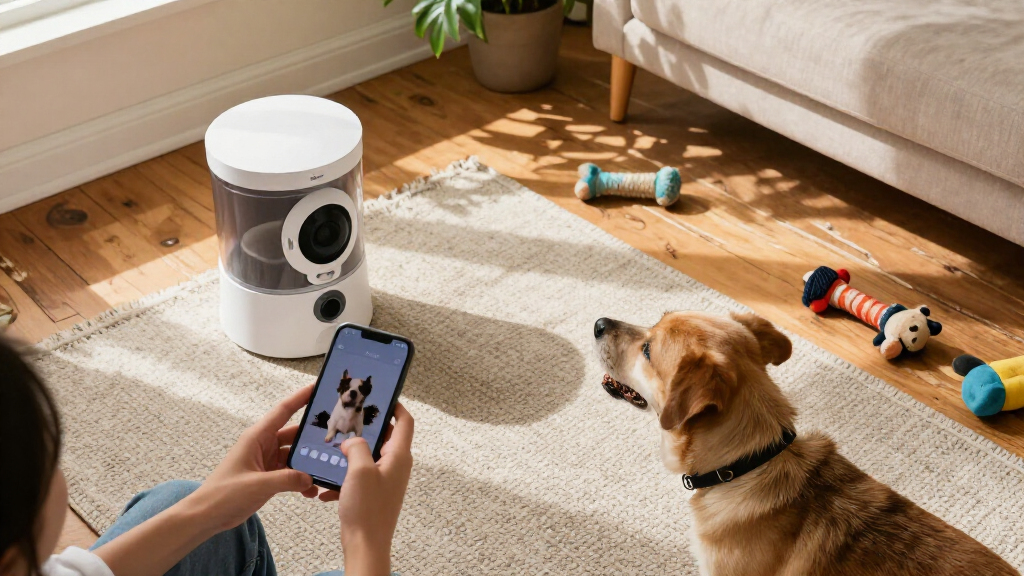
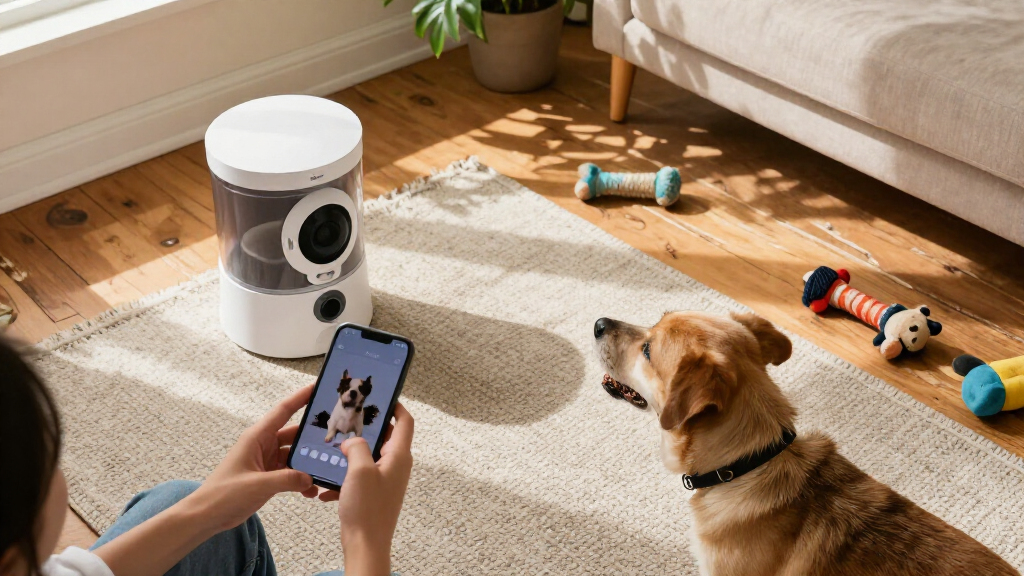
Interactive dog cameras with treat dispensers let you check in, talk to your dog, and offer a snack while you’re away, but they differ in how much play and control they add. My best overall pick is the Pmate AI Pet Camera Robot with 2K Video, which combines mobile interaction, treat feeding, and auto charging. The Cypcat 3K stands out for its 360-degree view and privacy cover, while the Petcube Bites 2 Lite suits buyers who want a more straightforward camera-and-treat setup. The main tradeoffs are mobility versus simplicity, camera coverage versus privacy, and interactive features versus setup and upkeep. Read on for the full breakdown and advice on matching a camera to your home and dog.

Get pet supplies delivered free with Prime
- Fast, free delivery on millions of items
- Prime Video, Amazon Music and more included
- Member-only deals all year
Complete the kit


Key Takeaways
- Mobile interaction sets the Pmate robot cameras apart: the 2K Pmate combines treat feeding, play, night vision, and auto charging, while the other Pmate listing adds automatic feeding but has no stated 2K video detail.
- The Cypcat 3K models prioritize coverage: the 360-degree Cypcat listing adds bark alerts and a privacy cover, while the M3 listing is identified by 3K video and treat dispensing.
- Pumpkii’s BQ75 and BQ70 add laser play to a robot format: that extra activity may suit dogs who respond to movement, but buyers should weigh it against a simpler stationary dispenser.
- SKYMEE has the widest set of listed variants: Petalk AI, Petalk AI II, and a Wi-Fi model with two-way audio and night vision give buyers several feature combinations to compare rather than one clear universal pick.
- The range runs from active robot cameras to simpler treat dispensers: Petcube Bites 2 Lite and TKENPRO 2K are camera-and-treat options, while the rotating remote-control model emphasizes directional control. Match the interaction style to your dog instead of treating more features as automatically better.
| Pmate AI Pet Camera Robot with 2K Video, Treat Feeding, Interactive Play, Night Vision, and Auto Charging |  | Best for Multi-Mode Play | Camera: 4MP, up to 2K recording; 1080p real-time video | Night vision: Infrared with headlights | Interaction: Two-way video and voice, treat feeding, ball throwing, teaser, and red-light play | VIEW LATEST PRICE | See Our Full Breakdown |
| Cypcat 3K Pet Camera with Treat Dispenser, 360° View, Bark Alerts, and Privacy Cover |  | Best for Long-Distance Treat Tossing | Video resolution: 3K | View: 360° pan-tilt | Maximum treat toss distance: 32 feet | VIEW LATEST PRICE | See Our Full Breakdown |
| Pumpkii BQ75 Pet Camera Robot with Treat Dispenser and Laser |  | Best for App-Controlled Mobile Play | Model: BQ75 | Video resolution: 2K | Night vision: Infrared | VIEW LATEST PRICE | See Our Full Breakdown |
| Pmate AI Pet Camera Robot with Auto Feeding, Interactive Play, Night Vision, and Auto Charging |  | Best for Automated Feeding and Follow Mode | Camera: Dual-camera design; 4MP wide-angle lens, up to 2K; 1080p real-time video | Night vision: Infrared with headlights | Interaction: Two-way voice and video, manual and automatic feeding, four-ball throwing, teaser, red-light play, and pet-calling sounds | VIEW LATEST PRICE | See Our Full Breakdown |
| SKYMEE Petalk AI Wi-Fi Dog Camera and Treat Dispenser | 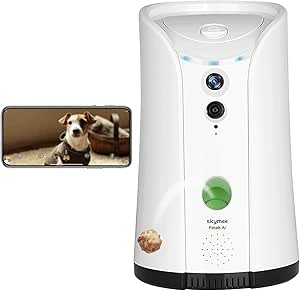 | Best for Shared Household Check-Ins | Video resolution: 1080p Full HD | Zoom and field of view: 4x digital zoom; 130° field of view | Audio: Two-way audio | VIEW LATEST PRICE | See Our Full Breakdown |
| Petcube Bites 2 Lite Wi-Fi Pet Camera with Treat Dispenser | 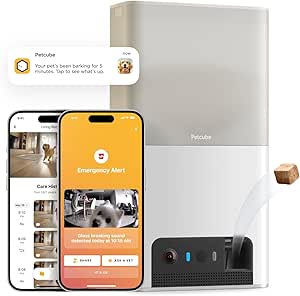 | Best for Scheduled Treat Routines | Video: 1080p; 110° field of view | Night vision: Up to 30 feet | Digital zoom: 8x | VIEW LATEST PRICE | See Our Full Breakdown |
| SKYMEE Petalk AI II Pet Camera with Automatic Treat Dispenser |  | Best for Shared Household Monitoring | Video: 1080p | Viewing angle: 180-degree pan | Digital zoom: 4x | VIEW LATEST PRICE | See Our Full Breakdown |
| Pumpkii BQ70 Pet Camera Robot with Treat Dispenser and Laser |  | Best for Room-to-Room Interaction | Camera: 1080p | Night vision: Infrared | Audio: Two-way | VIEW LATEST PRICE | See Our Full Breakdown |
| SKYMEE Petalk AI II Dog Camera with Auto Treat Dispenser |  | Best for Multi-User Play Features | Resolution: 1080p HD | Camera view: 180° PTZ rotation; 120° wide-angle lens | Zoom: 4× | VIEW LATEST PRICE | See Our Full Breakdown |
| TKENPRO 2K Pet Camera with Treat Dispenser | 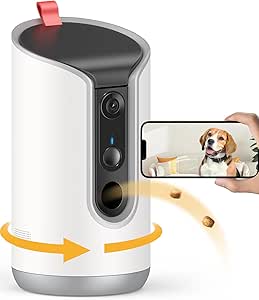 | Best for Higher-Detail Video and Tracking | Camera resolution: 2K | Pan rotation: 355° | Treat dispenser: 0.5 L capacity | VIEW LATEST PRICE | See Our Full Breakdown |
| Dog Camera Treat Dispenser, 360° Rotation Remote Control, Smart Pet Monitoring Camera |  | Best for Stable Room Coverage | Camera: 1080p, 2MP | Rotation: 360° | Material: ABS | VIEW LATEST PRICE | See Our Full Breakdown |
| SKYMEE Wi-Fi Dog Camera and Treat Dispenser with Two-Way Audio and Night Vision | | Best for Two-Way Interaction | Camera resolution: 1080p | Zoom: 4× | Night vision: Yes | VIEW LATEST PRICE | See Our Full Breakdown |
| Cypcat M3 3K Pet Camera with Treat Dispenser | | Best for High-Detail Coverage and Large Treat Capacity | Camera resolution: 3K | Field of view: 360° | Treat hopper: 300 ml; up to 300 treats | VIEW LATEST PRICE | See Our Full Breakdown |
| interactive dog cameras with treat dispenser | Night vision | Connectivity |
|---|---|---|
| Pmate AI Pet Camera Robot with | Infrared with headlights | Wi-Fi and app control |
| Cypcat 3K Pet Camera with Trea | — | 2.4 GHz and 5 GHz Wi-Fi |
| Pumpkii BQ75 Pet Camera Robot | Infrared | — |
| Pmate AI Pet Camera Robot with | Infrared with headlights | — |
| SKYMEE Petalk AI Wi-Fi Dog Cam | Infrared | 2.4 GHz Wi-Fi |
| Petcube Bites 2 Lite Wi-Fi Pet | Up to 30 feet | 2.4 GHz Wi-Fi; 5 GHz unsupported |
| SKYMEE Petalk AI II Pet Camera | Infrared LED | 2.4 GHz and 5 GHz Wi-Fi |
| Pumpkii BQ70 Pet Camera Robot | Infrared | 2.4 GHz Wi-Fi |
| SKYMEE Petalk AI II Dog Camera | Smart infrared | — |
| TKENPRO 2K Pet Camera with Tre | — | — |
| Dog Camera Treat Dispenser | — | — |
| SKYMEE Wi-Fi Dog Camera and Tr | Yes | — |
| Cypcat M3 3K Pet Camera with T | — | 2.4 GHz and 5 GHz Wi-Fi |
More Details on Our Top Picks
Pmate AI Pet Camera Robot with 2K Video, Treat Feeding, Interactive Play, Night Vision, and Auto Charging
The Pmate is the most play-focused pick in this group: it combines treat feeding with ball throwing, a cat teaser, red-light play, and a mobile camera that can track a pet. That makes it a stronger fit for dogs who need more than a treat toss while their owner is away. Its auto-return charging also reduces the chance of finding a drained robot when it is time for a check-in. Compared with the stationary SKYMEE Petalk AI, this Pmate can move around the room and offer more play options, but it also relies more on navigation and a clear indoor route. Real-time video is 1080p despite the camera’s 2K recording capability, and AI recognition works best in good light. Wi-Fi is required for app interaction; sleep mode provides a useful privacy cutoff.
Pros:- Combines treat feeding with ball throwing, teaser, and red-light play.
- Mobile tracking and obstacle avoidance offer more room coverage than a tabletop camera.
- Returns to its charger automatically.
- Sleep mode disables monitoring and recording, with sharing for up to four sub-accounts.
Cons:- 1080p is the stated real-time video resolution, even though recording supports up to 2K.
- AI visual recognition works best in well-lit conditions.
- App-based controls and interaction require Wi-Fi.
Best for: Owners of playful indoor dogs who want remote treat delivery, moving-camera monitoring, and several ways to prompt activity.
Not ideal for: People who need a simple, stationary camera or have unreliable Wi-Fi, cluttered floors, or dim rooms where AI recognition may be less dependable.
- Camera:4MP, up to 2K recording; 1080p real-time video
- Night vision:Infrared with headlights
- Interaction:Two-way video and voice, treat feeding, ball throwing, teaser, and red-light play
- AI recognition:Pet types and behaviors, including eating, sleeping, and playing
- Navigation:Path planning, obstacle avoidance, pet tracking, and automatic return to charger
- Connectivity:Wi-Fi and app control
- Account sharing:One main account and up to four sub-accounts
- Privacy:Sleep mode turns off monitoring and recording
Our verdict“Choose the Pmate if your dog benefits from varied remote play and mobile monitoring; pick a stationary camera if you want a simpler setup.”
Cypcat 3K Pet Camera with Treat Dispenser, 360° View, Bark Alerts, and Privacy Cover
The Cypcat TS01 stands out for a specific kind of interaction: it can toss treats up to 32 feet, giving an owner more reach than a nearby treat drop. Its 360° pan-tilt view and barking, whining, and movement detection make it better suited to watching a room from one fixed spot than a mobile robot such as the Pmate AI Pet Camera Robot. The Cypcat also has a physical lens cover, a straightforward privacy measure that does not depend on an app setting. A sealed 300 ml hopper helps keep treats contained, though treat shape and size may affect dispensing. Unlike the Pmate, it cannot follow a dog or provide moving play. It is an indoor, tabletop camera with corded power, so placement depends on both a suitable surface and a nearby outlet.
Pros:- Treat tossing reaches up to 32 feet for interaction across a room.
- 360° pan-tilt view helps cover areas beyond a fixed camera angle.
- Barking, whining, and movement detection provide several alert triggers.
- Physical sliding lens cover offers a direct way to block the camera.
Cons:- Indoor-only design does not suit patios or other outdoor monitoring.
- Corded power limits placement and requires an accessible outlet.
- Unlike the mobile Pmate, it does not track or follow a pet around the room.
Best for: Owners who want a stationary indoor camera that can toss treats across a larger room and monitor barking or movement.
Not ideal for: People who want a mobile camera, outdoor monitoring, or flexible placement away from a power outlet.
- Video resolution:3K
- View:360° pan-tilt
- Maximum treat toss distance:32 feet
- Treat hopper:Sealed, 300 ml capacity
- Connectivity:2.4 GHz and 5 GHz Wi-Fi
- Audio:Two-way audio
- Detection:Barking, whining, and movement
- Power and mounting:Corded electric; tabletop
- Privacy:Physical sliding lens cover
Our verdict“Pick the Cypcat for long-range treat tossing and broad stationary coverage, but choose a robot camera if your dog needs mobile interaction.”
Pumpkii BQ75 Pet Camera Robot with Treat Dispenser and Laser
The Pumpkii BQ75 brings mobile monitoring and laser play together in a robot designed for indoor floors and low rugs. Its 2K video, infrared night vision, and two-way audio cover the core check-in tasks, while the included 32 GB SD card gives buyers local storage without a monthly subscription for daily use. Compared with the stationary Cypcat TS01, the BQ75 can move around and engage a pet with a laser, but it gives up the Cypcat’s 360° fixed-room view and long-distance treat toss. Automatic return to the charging dock is useful, although it depends on the robot being able to navigate its route. Surface compatibility is a real constraint: rugs above 15 mm are outside the stated range. The listing identifies cats as the target species, so dog owners should check suitability for their pet.
Pros:- Combines 2K monitoring, two-way audio, treat dispensing, and laser play in a mobile unit.
- Includes a 32 GB SD card for local storage.
- Returns to its charging dock when the battery runs low.
- Daily use does not require a monthly subscription.
Cons:- Designed for indoor floors and low rugs up to 15 mm.
- Product data identifies cats as the target species, leaving dog suitability less clear.
- App control requires both Wi-Fi and a smartphone.
Best for: Tech-comfortable owners of small indoor pets who want a mobile camera, laser interaction, local video storage, and no monthly fee for daily use.
Not ideal for: Dog owners seeking a clearly dog-targeted device, homes with thick rugs or uneven floors, or anyone who needs app control without Wi-Fi.
- Model:BQ75
- Video resolution:2K
- Night vision:Infrared
- Interaction:Two-way audio, treat dispensing, and laser play
- Controls:PumPlus app over Wi-Fi
- Included storage:32 GB SD card
- Mobility:Automatic return to charging dock
- Surface compatibility:Indoor floors and rugs up to 15 mm
- Subscription:No monthly subscription required for daily use
Our verdict“Choose the BQ75 for mobile play and included local storage on compatible floors, but verify dog suitability before buying.”
Pmate AI Pet Camera Robot with Auto Feeding, Interactive Play, Night Vision, and Auto Charging
This Pmate is the better fit for owners who want more than occasional remote treat tossing: it lists manual and automatic feeding, pet calling sounds, follow mode, cruising, and several play modes. Its dual-camera design supports recording and obstacle avoidance, while automatic charging and pet tracking make it a more capable roaming option than the stationary SKYMEE Petalk AI. The feeding feature has a meaningful limitation: automatic feeding is activated through pet face recognition, and the product data says recognition works best in well-lit conditions. That makes it less dependable as a set-and-forget feeder than the word “automatic” might suggest. Real-time video is 1080p, not 2K, and the app depends on Wi-Fi. Sleep mode is a useful privacy control when remote monitoring is not wanted.
Pros:- Offers manual and automatic feeding alongside several play options.
- Follow mode, pet tracking, and obstacle avoidance support mobile monitoring.
- Automatically returns to charge.
- Sleep mode turns off monitoring and recording, and the app supports four sub-accounts.
Cons:- Automatic feeding depends on pet face recognition, which works best in well-lit conditions.
- Real-time video is 1080p despite 2K camera resolution.
- Wi-Fi is required for app controls and interaction.
Best for: Owners who want a roaming camera with follow mode, scheduled-style interaction options, and automatic feeding triggered by pet recognition.
Not ideal for: Buyers who need feeding to work reliably in dim rooms, want a dedicated meal feeder, or prefer a stationary camera with fewer moving parts.
- Camera:Dual-camera design; 4MP wide-angle lens, up to 2K; 1080p real-time video
- Night vision:Infrared with headlights
- Interaction:Two-way voice and video, manual and automatic feeding, four-ball throwing, teaser, red-light play, and pet-calling sounds
- Pet recognition:Recognizes pet types and behaviors; works best in well-lit conditions
- Navigation:Path planning, obstacle avoidance, pet tracking, follow mode, and auto cruising
- Charging:Automatic return to charge
- Connectivity and sharing:Wi-Fi app control; one main account and four sub-accounts
- Privacy:Sleep mode turns off monitoring and recording
Our verdict“Choose this Pmate for roaming follow mode and recognition-triggered feeding, but not as a replacement for a dedicated feeder or low-light monitor.”
SKYMEE Petalk AI Wi-Fi Dog Camera and Treat Dispenser
The SKYMEE Petalk AI is a straightforward stationary choice for households where several people want to check in on the dog. Its app can be shared across up to eight devices, and motion alerts, two-way audio, infrared night vision, and remote treat tossing cover the main at-home interaction needs. Compared with the mobile Pmate AI Pet Camera Robot, the SKYMEE has no roaming, follow mode, or varied play tools; in return, it avoids the added navigation complexity of a robot. The 130-degree view and 4x digital zoom help with a fixed camera angle, though digital zoom is not the same as a moving 360° view like the Cypcat TS01. Treat size is another practical limit: the recommended range is 0.6–1.1 cm. It also supports only 2.4 GHz Wi-Fi, so check router compatibility before choosing it.
Pros:- Shared access supports up to eight devices.
- Remote treat dispensing pairs with two-way audio for simple check-ins.
- Infrared night vision and motion alerts support monitoring after dark and between app checks.
- 4x digital zoom and a 130-degree field of view help inspect a fixed viewing area.
Cons:- Works with 2.4 GHz Wi-Fi only, not 5 GHz.
- Recommended treat size is limited to 0.6–1.1 cm.
- Unlike the Pmate robot or Cypcat pan-tilt camera, it does not move to follow a dog or change its viewing direction.
Best for: Households where several family members want app access to a stationary dog camera with treat tossing and basic two-way communication.
Not ideal for: Buyers whose router uses only 5 GHz Wi-Fi, or owners who want mobile tracking, room-wide pan-tilt coverage, or larger treats.
- Video resolution:1080p Full HD
- Zoom and field of view:4x digital zoom; 130° field of view
- Audio:Two-way audio
- Night vision:Infrared
- Alerts:Motion detection
- Connectivity:2.4 GHz Wi-Fi
- Smart home compatibility:Amazon Alexa
- Shared access:Up to eight devices
- Recommended treat size:0.6–1.1 cm
Our verdict“Choose the SKYMEE if shared access and simple treat-based check-ins matter most and your home has compatible 2.4 GHz Wi-Fi.”
Petcube Bites 2 Lite Wi-Fi Pet Camera with Treat Dispenser
The Petcube Bites 2 Lite suits owners who want treat dispensing to be part of a routine, not only a response to a live app session: it supports scheduled dispensing alongside remote tossing. Its dishwasher-safe dispenser also makes regular use less of a cleanup chore. The 1080p camera, night vision, two-way audio, and tabletop or wall mounting cover everyday check-ins, while Alexa control offers another way to trigger a reward. Compared with the SKYMEE Petalk AI II, this model offers a stated 1.5-pound container and scheduled treats, but lacks 5 GHz Wi-Fi and the SKYMEE’s 180-degree pan. Its motion and sound notifications require an optional subscription, so buyers seeking alerts without an added plan should look elsewhere.
Pros:- Scheduled and app-triggered treat dispensing
- Dishwasher-safe dispenser with short-, medium-, and long-distance toss settings
- 1080p video with night vision and 8x digital zoom
- Tabletop or wall mounting accommodates different room layouts
Cons:- Connects only to 2.4 GHz Wi-Fi
- Motion and sound notifications require an optional subscription
- Corded power limits placement to areas near an outlet
Best for: Owners who want a large treat supply, scheduled rewards, and flexible tabletop or wall placement for one indoor pet.
Not ideal for: Homes with only 5 GHz Wi-Fi or buyers who want motion and sound notifications without an optional subscription.
- Video:1080p; 110° field of view
- Night vision:Up to 30 feet
- Digital zoom:8x
- Treat container:1.5 lbs
- Treat dispensing:Dishwasher-safe; short-, medium-, and long-distance tossing; scheduled dispensing
- Connectivity:2.4 GHz Wi-Fi; 5 GHz unsupported
- Audio:Two-way audio
- Mounting and power:Tabletop or wall mount; corded electric
Our verdict“Choose the Petcube if scheduled dispensing and a cleanable, higher-capacity treat container matter more than 5 GHz Wi-Fi or subscription-free alerts.”
SKYMEE Petalk AI II Pet Camera with Automatic Treat Dispenser
For a household where several people take turns checking in, the SKYMEE Petalk AI II stands out with app access for up to eight people and support for both 2.4 and 5 GHz Wi-Fi. Its 180-degree pan helps users scan more of a room than the fixed-view Petcube Bites 2 Lite, while two treat trays accommodate snacks in two specified size ranges. That flexibility depends on choosing treats that fit those ranges; it is not an all-purpose dispenser. The camera also has 1080p video, infrared night vision, two-way audio, and 4x zoom. Unlike the mobile Pumpkii BQ70, it stays in one location, so it cannot follow a dog between rooms. Wall mounting and corded power also call for a planned installation spot.
Pros:- App access supports up to eight people
- Works with both 2.4 and 5 GHz Wi-Fi
- 180-degree camera pan with infrared night vision
- Two tray options cover two specified treat size ranges
Cons:- Treat compatibility is limited to 11–14 mm and 14–17 mm ranges
- Corded power restricts placement
- Wall mount and stationary design do not provide room-to-room coverage
Best for: Families, pet sitters, or shared-care households that want multiple app users and wider Wi-Fi compatibility from a fixed camera.
Not ideal for: Owners whose dogs move between rooms, or anyone who uses treats outside the listed 11–17 mm size ranges.
- Video:1080p
- Viewing angle:180-degree pan
- Digital zoom:4x
- Night vision:Infrared LED
- Treat compatibility:Two trays for 11–14 mm and 14–17 mm treats
- Connectivity:2.4 GHz and 5 GHz Wi-Fi
- App access:Up to 8 people
- Mounting and power:Wall mount; corded electric
Our verdict“Pick this SKYMEE for shared access and a pan-capable fixed view, provided your treats fit its tray sizes and a wall-mounted location works.”
Pumpkii BQ70 Pet Camera Robot with Treat Dispenser and Laser
The Pumpkii BQ70 takes a different approach from fixed dispensers: it is a mobile camera robot that owners can steer through indoor spaces, combining remote viewing with treat delivery, two-way audio, and laser play. That makes it more suited to checking on a dog in different rooms than the stationary SKYMEE Petalk AI II, whose 180-degree pan covers a wider view from one mounting point. The BQ70 runs on battery and returns to its dock when power runs low, reducing the need to keep it plugged into one location. The tradeoff is that it depends on a navigable floor, supports only small dry treats, and works on rugs up to 15 mm thick. Its 2.4 GHz-only Wi-Fi also makes it a poor fit for homes set up exclusively on 5 GHz.
Pros:- Mobile design can check on pets in different rooms
- Combines remote treat dispensing, two-way audio, and laser play
- Battery operation with automatic return to the charging dock
- Infrared night vision supports low-light monitoring
Cons:- Treat dispenser is designed for small dry treats
- Works with 2.4 GHz Wi-Fi only
- Designed for rugs no thicker than 15 mm
Best for: Owners of indoor dogs who move between accessible rooms and would benefit from remote movement, treat rewards, and laser play.
Not ideal for: Homes with thick rugs, pets that need larger or moist treats, or Wi-Fi networks limited to 5 GHz.
- Camera:1080p
- Night vision:Infrared
- Audio:Two-way
- Treat dispenser:For small dry treats
- Connectivity:2.4 GHz Wi-Fi
- Power:Battery powered
- Charging:Returns to charging dock automatically when battery is low
- Maximum rug thickness:15 mm
Our verdict“Choose the BQ70 if moving around the home and adding play are more useful to you than the fixed camera coverage offered by the SKYMEE Petalk AI II.”
SKYMEE Petalk AI II Dog Camera with Auto Treat Dispenser
This SKYMEE Petalk AI II is a good match for households that want more than remote viewing and a treat toss: its interactive games, motion alerts, two-way audio, and simultaneous access for up to eight users give family members several ways to check in. A 180-degree PTZ camera, 120-degree wide-angle lens, and 4x zoom help cover a room, while its two trays accept snacks from 11–17 mm. Compared with the earlier SKYMEE Petalk AI II in this lineup, this version’s listed Wi-Fi is limited to 2.4 GHz rather than supporting both bands; it also specifies two trays fitting a broader combined size range. The TKENPRO 2K offers higher stated resolution and 5 GHz support, but not the same listed multi-user game feature set. Treat size and network compatibility are the main limits here.
Pros:- Up to eight users can view simultaneously
- Interactive games complement remote treat dispensing
- 180-degree PTZ rotation with a 120-degree wide-angle lens
- Smart infrared night vision switches automatically in darkness
Cons:- Supports 2.4 GHz Wi-Fi only
- Treat trays fit snacks sized 11–17 mm
- USB power requires a suitable outlet location
Best for: Households with several caregivers who want shared camera access, interactive games, and treat dispensing for compatible snacks.
Not ideal for: Homes relying on 5 GHz Wi-Fi or owners whose usual treats fall outside the 11–17 mm range.
- Resolution:1080p HD
- Camera view:180° PTZ rotation; 120° wide-angle lens
- Zoom:4×
- Night vision:Smart infrared
- Treat trays:Two trays; fits 11–17 mm snacks
- Wi-Fi:2.4 GHz only
- Multi-user access:Up to 8 users simultaneously
- Power:USB
Our verdict“Choose this model over the TKENPRO 2K if shared access and interactive games matter more than higher resolution and dual-band Wi-Fi.”
TKENPRO 2K Pet Camera with Treat Dispenser
The TKENPRO 2K stands out for buyers who want sharper stated resolution and a camera that can follow movement: it combines 2K video, 355-degree pan, AI auto tracking, and motion and bark detection. For monitoring a dog that moves around within one room, that tracking may be more useful than the Petcube Bites 2 Lite‘s fixed 110-degree view. The TKENPRO also supports both 2.4 and 5 GHz Wi-Fi, unlike either SKYMEE model listed here. Treat delivery is more constrained: the dispenser holds 0.5 L and is recommended for 7–15 mm treats. Recording can go to a memory card up to 128 GB, but the card is not included; cloud recording options include subscription-dependent features. It is stationary and indoor-only, unlike the mobile Pumpkii BQ70.
Pros:- 2K video with 355-degree pan rotation
- AI auto tracking with motion and bark detection
- Supports both 2.4 and 5 GHz Wi-Fi
- Offers memory-card recording as well as cloud recording options
Cons:- Recommended treat size is limited to 7–15 mm
- Memory card is not included, and some cloud features require a subscription
- Indoor-only camera is stationary rather than mobile
Best for: Owners who want higher-detail indoor video, broad pan coverage, and tracking for a dog that moves around one room.
Not ideal for: Buyers seeking a mobile camera robot, a large treat reservoir, or cloud recording features without a subscription.
- Camera resolution:2K
- Pan rotation:355°
- Treat dispenser:0.5 L capacity
- Recommended treat size:7–15 mm
- Wi-Fi:2.4 GHz and 5 GHz
- Detection and tracking:Motion and barking detection; AI auto tracking
- Recording:Cloud recording; memory card support up to 128 GB, card not included
- Use:Indoor
Our verdict“Pick the TKENPRO over the fixed-view Petcube if resolution, tracking, and dual-band Wi-Fi are your priorities and its treat-size limits suit your dog.”
Dog Camera Treat Dispenser, 360° Rotation Remote Control, Smart Pet Monitoring Camera
360° rotation and a suction-cup base make this a sensible pick for buyers who want a fixed view of a room and remote treat rewards. Its 1080p, 2MP camera offers a clear view, while the app-controlled dispenser lets you respond without being home. Compared with the SKYMEE Wi-Fi Dog Camera, this model emphasizes a rotating camera and stable placement rather than listed night vision, zoom, and two-way audio. The anti-jam dispenser is a practical plus for routine treat tossing, but the supplied details do not specify treat-size limits or audio features. It also needs constant power, so it is less suited to flexible placement or locations without a nearby outlet.
Pros:- 1080p, 2MP video with 360° camera rotation
- App-controlled remote treat dispensing
- Suction-cup base helps keep the unit stable
- Anti-jam dispenser design
Cons:- Requires constant power and has no battery backup
- Two-way audio and night vision are not specified
- Treat-size compatibility is not provided
Best for: Dog owners who want a powered, fixed indoor camera with rotating room coverage and app-based treat dispensing.
Not ideal for: People who need battery-backed operation, two-way audio, or documented night vision; this model requires a constant power connection and those features are not listed.
- Camera:1080p, 2MP
- Rotation:360°
- Material:ABS
- Power:Constant power connection required; no battery backup
- Plug:US plug; 100–240 V
- Weight:1.09 kg
- Dispenser features:Remote app control; anti-jam design
- Base:Suction-cup base
Our verdict“Choose this for stable, powered 360° room monitoring and remote rewards, but pick the SKYMEE if night vision and two-way audio matter more.”
SKYMEE Wi-Fi Dog Camera and Treat Dispenser with Two-Way Audio and Night Vision
Two-way audio, night vision, and motion alerts give this SKYMEE a stronger interaction toolkit than the Xcello rotating camera, whose listed features center on room coverage and treat dispensing. The 4× zoom can help check what a dog is doing without moving the camera, and shared app access for up to eight devices suits households where several people take turns checking in. Treats should measure 0.6–1.1 cm, so owners may need to change what they load if their usual rewards fall outside that range. The 2.4 GHz-only Wi-Fi requirement may also rule it out in homes set up exclusively for 5 GHz. Compared with the Cypcat M3, it offers specified audio and night vision, but not listed 3K video or 360° coverage.
Pros:- 1080p video with 4× zoom and night vision
- Two-way audio supports remote check-ins
- Motion alerts can notify owners of activity
- App access can be shared with up to eight devices
Cons:- Supports 2.4 GHz Wi-Fi only, not 5 GHz
- Treats need to fit the recommended 0.6–1.1 cm range
- Not water resistant
Best for: Households that want remote voice interaction, night monitoring, and shared camera access, and can connect to 2.4 GHz Wi-Fi.
Not ideal for: Owners whose router setup is 5 GHz-only or whose preferred treats fall outside the recommended 0.6–1.1 cm range.
- Camera resolution:1080p
- Zoom:4×
- Night vision:Yes
- Audio:Two-way
- Recommended treat size:0.6–1.1 cm
- Wi-Fi:2.4 GHz; not compatible with 5 GHz
- Shared access:Up to 8 devices
- Alexa compatibility:Yes
Our verdict“Pick the SKYMEE for voice check-ins and night monitoring with shared access, provided your Wi-Fi and treats meet its limits.”
Cypcat M3 3K Pet Camera with Treat Dispenser
The Cypcat M3 pairs 3K video with 360° coverage, making it the strongest fit here for buyers who want broad, detailed indoor monitoring. Its 300 ml sealed hopper holds up to 300 treats, and the dispenser can toss them as far as 23 ft—more reach and stated capacity than the Xcello, which lists remote dispensing but no hopper size or toss distance. Barking detection adds another way to notice activity, while the physical lens cover gives owners a direct privacy control. It also supports both 2.4 GHz and 5 GHz Wi-Fi, unlike the 2.4 GHz-only SKYMEE. The tradeoff is that connected functions depend on Wi-Fi and the phone app, and this is an indoor-only camera; buyers seeking a mobile robot rather than a fixed camera should look elsewhere.
Pros:- 3K video with 360° coverage
- 300 ml hopper holds up to 300 treats
- Treat toss distance reaches up to 23 ft
- Physical lens cover and 2.4/5 GHz Wi-Fi support
Cons:- Designed for indoor use only
- Connected features require Wi-Fi and the phone app
- Fixed camera design is not a substitute for a mobile pet robot
Best for: Owners seeking detailed 360° indoor monitoring, a large treat supply, and support for either 2.4 GHz or 5 GHz Wi-Fi.
Not ideal for: People who need outdoor monitoring, want to avoid app-dependent connected features, or prefer a camera that moves around the home.
- Camera resolution:3K
- Field of view:360°
- Treat hopper:300 ml; up to 300 treats
- Maximum treat toss distance:23 ft
- Connectivity:2.4 GHz and 5 GHz Wi-Fi
- Special features:Barking detection; phone app; sliding physical lens cover
- Usage:Indoor
- Dimensions:7.24 × 5.4 × 6.6 inches
Our verdict“Choose the Cypcat M3 for high-detail 360° indoor coverage and generous treat capacity, but skip it if you need outdoor use or mobile play.”
How We Picked
I compared the 13 listed models on the features that change the day-to-day experience: video detail and viewing coverage, treat dispensing, two-way interaction, mobility or play, night vision, alerts, privacy features, and auto charging. I also looked at how clearly each listing identifies those capabilities. A camera that names its key functions gives buyers a more useful basis for comparison than one whose listing leaves important details unspecified.
The ranking favors useful combinations of monitoring and interaction, then distinguishes cameras for coverage, active play, simpler operation, or a particular feature set. I gave no model an assumed advantage for capabilities not stated in its product name. That means close variants, such as the SKYMEE Petalk AI II listings or Pumpkii BQ70 and BQ75, should be checked against their current full specifications before purchase; the roundup separates their stated identities without claiming unlisted performance differences.
| interactive dog cameras with treat dispenser | Night vision |
|---|---|
| Pmate AI Pet Camera Robot with | Infrared with headlights |
| Cypcat 3K Pet Camera with Trea | — |
| Pumpkii BQ75 Pet Camera Robot | Infrared |
| Pmate AI Pet Camera Robot with | Infrared with headlights |
| SKYMEE Petalk AI Wi-Fi Dog Cam | Infrared |
| Petcube Bites 2 Lite Wi-Fi Pet | Up to 30 feet |
| SKYMEE Petalk AI II Pet Camera | Infrared LED |
| Pumpkii BQ70 Pet Camera Robot | Infrared |
| SKYMEE Petalk AI II Dog Camera | Smart infrared |
| TKENPRO 2K Pet Camera with Tre | — |
| Dog Camera Treat Dispenser | — |
| SKYMEE Wi-Fi Dog Camera and Tr | Yes |
| Cypcat M3 3K Pet Camera with T | — |
Factors to Consider When Choosing Interactive Dog Cameras With Treat Dispensers
The right camera is not simply the one with the longest feature list. Start with how your dog behaves when alone, where the camera will sit, and whether you want a snack dispenser, a remote play device, or both. These decisions can prevent a mismatched purchase and make the features you pay attention to more useful.
Choose Interaction Your Dog Will Actually Use
A treat dispenser can be a useful cue or reward, but it is not a substitute for exercise, training, or company. Consider whether your dog responds calmly to hearing your voice and whether movement or laser-style play tends to engage them. Some dogs may get excited by remote play; others may bark, chase, or become frustrated when the activity stops. If you are unsure, begin with a camera that lets you observe and speak before relying on frequent play prompts. Choose a mobile robot only if your dog is comfortable with a device moving around the room. A simpler stationary camera may be a better match for a dog who prefers predictable routines.
Plan the Camera’s View Before Buying
Think about the room layout, not just the camera’s advertised resolution. A wide or rotating view can help cover an open space, while furniture, corners, and low placement can still leave blind spots. Higher stated video resolution may help you see more detail, but it cannot compensate for a poor angle or an unstable connection. Choose a location with a clear view of the area where your dog rests, and check that the dispenser can reach the dog without placing food near cables or fragile objects. If the camera will face a private area, a physical privacy cover may matter more than a small difference in resolution. Do not assume that a 360-degree label means every part of a room is visible at once.
Check Treat Size, Storage, and Cleaning Needs
Before buying, check the dispenser’s supported treat size and shape in the full product specifications. Treats that are too large, soft, oily, or irregular can be harder to dispense reliably, and a camera’s feature name alone does not confirm compatibility. Think about how often you will refill the unit and whether the food chamber and dispensing path are accessible for cleaning. If your dog has dietary restrictions, reserve a consistent type of treat and account for remote rewards in their daily food intake. A larger or more elaborate device is not automatically easier to maintain. Treat dispensing is only convenient when the food you use works with the mechanism and the parts stay clean.
Decide Whether Mobility Is Worth the Extra Complexity
Robot cameras can add movement and play, but mobility brings different needs from a stationary unit. The floor should be clear enough for the device to move, and your dog needs to be comfortable with a camera approaching or changing position. Auto charging can reduce the burden of keeping a mobile device ready, but it does not remove the need to check its route and charging setup. Stationary cameras usually make more sense when you mainly want to look in, speak, and dispense a treat from one spot. Do not pay for movement if your dog will ignore it or find it stressful. For a first camera, a simpler setup can make it easier to learn which forms of remote interaction your dog enjoys.
Separate Must-Have Features From Nice-to-Haves
Build a short priority list before comparing model names: for example, night vision for evening check-ins, two-way audio for talking, bark alerts for monitoring noise, or a privacy cover for control over the lens. These functions solve different problems, so a longer feature list does not automatically mean a better fit. Check whether the exact listing includes each feature; similar model names can refer to different configurations. Also look for details about app access, Wi-Fi requirements, recording, and any ongoing service needs in the manufacturer’s current information, since those details are not established by a product name alone. Give priority to the feature that addresses your real routine, not a feature that sounds impressive but will rarely be used. That approach makes comparisons between variants more meaningful.
Match the Device to Your Dog’s Temperament and Home
A confident, playful dog may enjoy remote movement or laser play, while a noise-sensitive or easily startled dog may prefer a stationary camera with predictable audio. In a multi-pet household, check whether every animal can reach the dispenser and whether one pet might claim the treats. Consider where cords, furniture, and the charging point sit, especially if you are choosing a mobile model. If your dog guards food or becomes overexcited by treats, remote dispensing may need careful limits and training. A camera should support your routine rather than create a new source of stress. When behavior is uncertain, prioritize observation and gradual introduction over the most interactive feature set.
Frequently Asked Questions
Should I choose a mobile robot camera or a stationary treat dispenser?
Choose a mobile robot if your dog is comfortable around moving devices and you want play to be part of remote check-ins. A stationary dispenser is usually a simpler fit when your main goals are viewing, talking, and giving an occasional treat from a fixed spot. Mobility also asks more of the room: floor clutter, furniture, and a suitable charging area can affect usefulness. Consider your dog’s reaction before paying for movement features. If you are uncertain, a fixed camera can provide a calmer starting point.
How can I tell whether a camera will dispense my dog’s treats?
Check the exact model’s specifications for supported treat dimensions and shapes rather than relying on the phrase “treat dispenser.” Product names in this lineup do not provide enough detail to confirm compatibility for every food type. Avoid assuming that large, soft, sticky, or unusually shaped treats will pass through the mechanism. If the manufacturer lists compatible treats, use that guidance and test the dispenser while you are home. For dogs with dietary limits, also account for remote treats in their daily feeding plan.
Is a 3K camera necessarily a better choice than a 2K camera?
Not on resolution alone. A higher stated resolution may offer more image detail, but camera placement, lighting, network reliability, and viewing angle all shape what you can actually see. The Cypcat 3K models emphasize video detail, while the Pmate 2K robot combines its stated resolution with mobility, play, night vision, and auto charging. If you need broad room coverage, a rotating view may matter more than a resolution label. Choose based on the problem you need the camera to solve.
Do I need bark alerts, night vision, or a privacy cover?
These features are useful for different routines, not universal requirements. Bark alerts can help you notice noise while away, night vision supports dim-room viewing, and a privacy cover gives you a physical way to block the lens. If you check in mostly during daylight and do not need noise notifications, those features may be secondary to a reliable view and compatible treat dispensing. If the camera faces a space where you want control over when it watches, a cover can be a meaningful differentiator. Compare the exact model listing, since not every similarly named version lists the same functions.
How should I introduce a treat camera to a dog that gets excited or nervous?
Set it up while you are home and let your dog inspect it without immediately activating movement or dispensing treats. Start with brief, calm audio or a single treat, then watch for signs of excitement, barking, avoidance, or guarding. For a robot model, introduce movement gradually and keep the floor clear so the device does not surprise your dog around furniture. If your dog becomes unsettled, pause remote play and use the camera for observation until they are comfortable. Dogs with food guarding or strong treat arousal may need a different interaction routine.
Conclusion
For the broadest mix of remote play and monitoring, I recommend the Pmate AI Pet Camera Robot with 2K Video as the best overall pick. The Petcube Bites 2 Lite is my best value-style choice for buyers who prefer a more straightforward camera-and-treat setup, while the Pmate AI Pet Camera Robot with Auto Feeding is the best premium-style fit for those drawn to a mobile robot with automatic feeding and play. For beginners, I would start with the simpler Petcube Bites 2 Lite rather than a moving camera. Choose the Cypcat 3K with 360-degree view if coverage, bark alerts, and a privacy cover are your priorities; pick a Pumpkii BQ75 or BQ70 if laser play is central to your dog’s engagement. Before ordering, confirm the exact variant’s app, treat compatibility, and listed features, since several names in this roundup refer to closely related models.